

Every week, I hear some variation of the same exchange in enterprise architecture conversations. A CIO says: “We need human oversight for our AI agents.” The team nods. Everyone agrees. And then no one can answer the follow-up question: What kind of oversight, for which agents, at which tier of autonomy, with what escalation paths, and who is accountable when the agent makes a decision the human never saw?
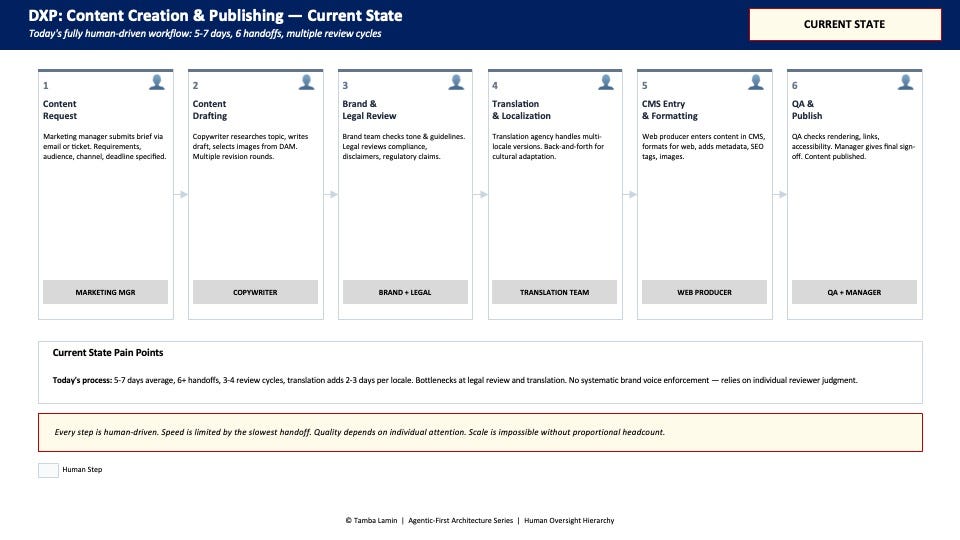
That ambiguity isn’t a communication problem. It’s an architectural failure. And in an era where AI agents are making autonomous procurement decisions, drafting legal responses, managing supply chains, and triaging patient data, architectural ambiguity in governance is organizational risk.
In the first four articles of this series, I built the structural framework for Agentic-First systems: the paradigm shift (Article 1), the protocol stack that connects agents to tools (MCP, Article 2) and to each other (A2A, Article 3), and the six-core-layer reference architecture with Security & Identity and Governance & Observability as cross-cutting layers (Article 4). The architecture is complete. The protocols are defined. The question that remains is whether any of it can be deployed responsibly: How much autonomy should we actually give our agents?
The answer is not a binary “fully autonomous” or “fully human-controlled.” It’s a precisely defined hierarchy; a spectrum of human oversight that maps to different use cases, risk profiles, regulatory requirements, and maturity levels. This article defines that hierarchy.
The Control Theory Foundation: Where “The Loop” Actually Comes From
Before defining any governance model, we need to ground the terminology, because the origin determines the meaning, and sloppy terminology leads to sloppy architecture.
The phrase “the loop” refers to the control feedback loop in automated systems. This concept does not originate from AI marketing, vendor pitch decks, or LinkedIn thought pieces. It comes from control theory, cybernetics, and decades of human-machine interaction research, the same engineering disciplines that produced autopilot systems, industrial process control, nuclear plant safety architectures, and autonomous vehicle design frameworks.
In control theory, “the loop” is the cycle through which a system senses its environment, processes information, makes a decision, takes an action, and receives feedback on the outcome. The human’s relationship to this loop, whether they participate in it, observe it from the outside, rely on its outputs, or govern it from above, determines the governance model.
This distinction matters for architects because the placement of the human relative to the loop has direct architectural implications. A system with Human-in-the-Loop governance requires approval workflow infrastructure, decision queues, and blocking mechanisms that halt agent execution until human authorization is received. A system with Human-on-the-Loop governance requires real-time observability dashboards, anomaly-detection engines, and rapid-intervention capabilities, fundamentally different infrastructure. Conflating these models, or using the terms interchangeably, means building the wrong infrastructure for the wrong governance model.
In this context:
Inside the loop → participating in the decision process
On the loop → supervising the system
Under the loop → relying on the system’s outputs
Above the loop → governing the system’s policies
Because the “loop” is a precise engineering concept, the governance models derived from it are equally precise. Each model describes a structurally different relationship between the human and the automated system, not a preference or a philosophy, but an architectural pattern with specific infrastructure requirements.
The Four Loop Models
Human in the Loop (HITL) - Approval
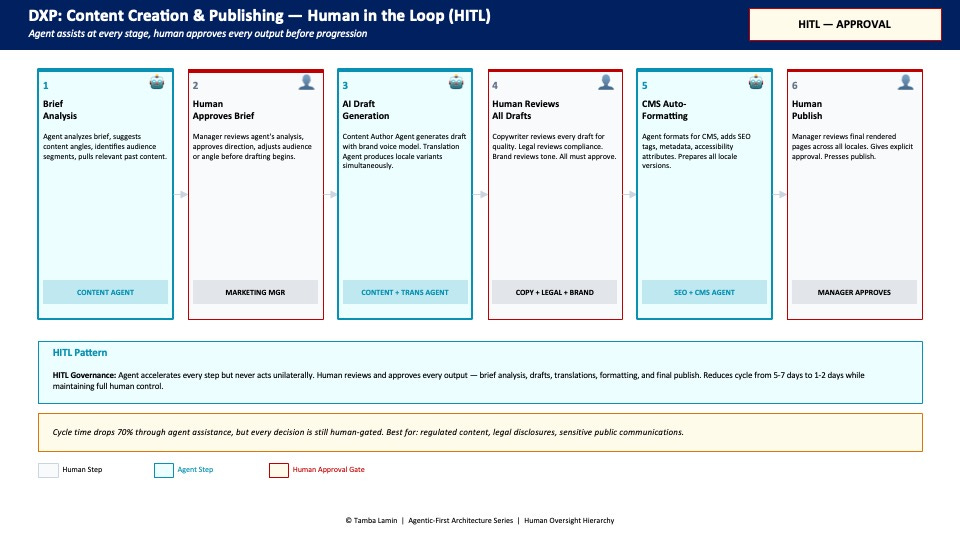
The human is inside the decision loop. The agent senses, reasons, and proposes, but nothing happens until the human explicitly approves. Every significant action is gated by human authorization.
In an Agentic-First system, HITL means the agent drafts a customer communication, which a human reviews and sends. The agent recommends a procurement decision, but a human signs the purchase order. The agent identifies a compliance risk, but a human decides the remediation. The agent never acts unilaterally on consequential decisions.
HITL is the appropriate model for high-stakes, irreversible, or regulated decisions: financial transactions above defined thresholds, medical recommendations, legal determinations, public communications on sensitive topics, and any domain where the regulatory framework requires explicit human authorization. It provides maximum control at the cost of speed and scalability — every decision is bottlenecked by human availability, attention, and cognitive capacity.
In the maturity model in Article 4, HITL is the default governance model for Tier 1 (Foundation)—the starting point for every agentic deployment before organizational trust has been established through demonstrated reliability.
The EU AI Act, whose high-risk system requirements become fully enforceable in August 2026, embeds what it calls a “human-in-command” philosophy: high-risk AI must be designed so that human supervisors can understand the system’s limitations, detect anomalies, avoid automation bias, and intervene or override system outputs. For high-risk deployments, HITL isn’t just an architectural choice — it’s a regulatory requirement.
Human on the Loop (HOTL) — Supervision
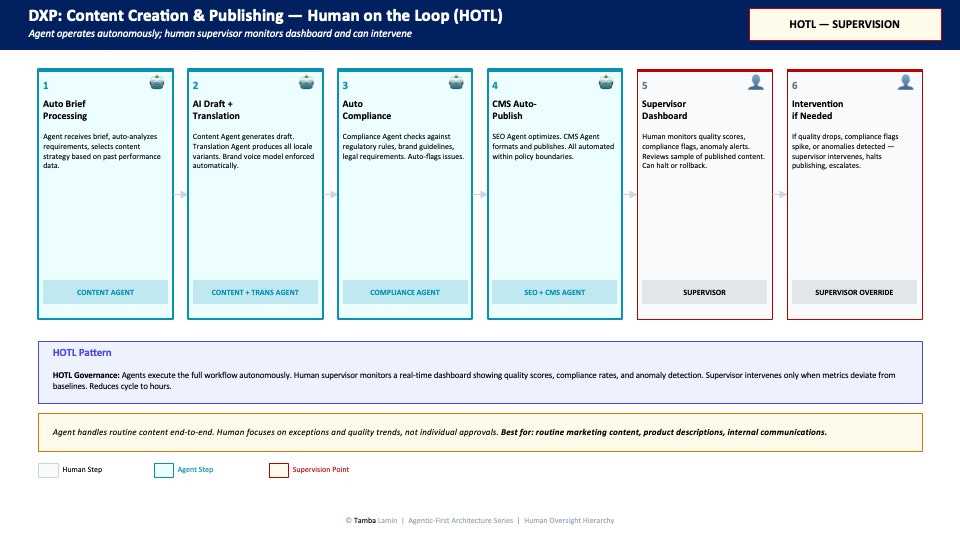
The human is watching the loop from outside. The agent operates autonomously — sensing, deciding, and acting — while the human monitors a real-time oversight surface and can intervene when the agent’s behavior deviates from expectations or when predefined thresholds are breached.
In an Agentic-First system, HOTL means the agent processes customer service tickets autonomously, while a supervisor reviews a dashboard of the agent’s decisions, accuracy rates, and escalation patterns. The agent manages inventory reordering within defined parameters while a supply chain manager monitors for anomalies. The agent generates and publishes routine content while an editor reviews output quality metrics and can halt publication if the quality score drops.
HOTL is appropriate for medium-risk, reversible decisions where the volume is too high for human approval of every action, but the consequences of error are significant enough to require active monitoring. It demands robust observability infrastructure: real-time dashboards showing agent behavior and decision patterns, anomaly detection that alerts supervisors when agent behavior deviates from baselines, reasoning chain transparency so supervisors can understand why an agent made a specific decision, and rapid intervention capabilities that allow the human to halt, override, or redirect agent behavior within seconds.
In the maturity model, HOTL is the governance model for Tier 2 (Workflow Automation) — the stage where agents have demonstrated reliability through Tier 1 deployment and earned enough organizational trust to operate with supervision rather than explicit approval.
Human under the Loop (HUTL) — Reliance
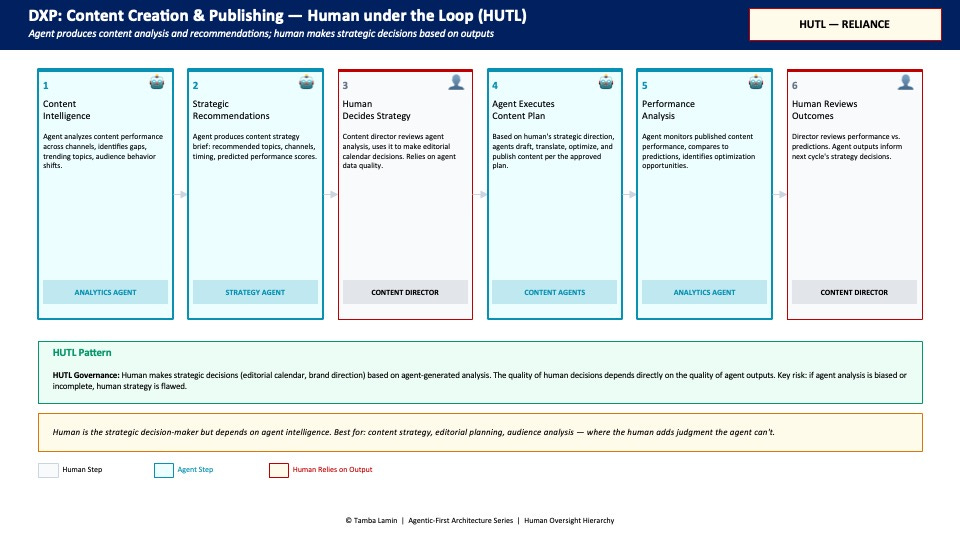
The human is beneath the loop — relying on the agent’s outputs to inform their own decisions and work. The agent operates autonomously and produces results; the human consumes those results without directly supervising the operational process that generated them.
In an Agentic-First system, HUTL means a financial analyst receives an agent-generated market analysis and uses it to inform investment recommendations. A physician reviews an agent-produced differential diagnosis as input to clinical judgment. A marketing director acts on agent-generated campaign performance insights without overseeing how the data was collected and analyzed.
HUTL might seem like the lowest-oversight model, but it introduces a unique and often underappreciated risk: humans are making consequential decisions based on agent outputs, often without the ability or inclination to verify the underlying analysis. If the agent produces flawed, biased, or incomplete outputs, the human makes flawed decisions — frequently without realizing the foundation is unreliable. The NIST AI Risk Management Framework specifically addresses this by emphasizing output validation, transparency, and explainability requirements.
The critical governance investment for HUTL is output quality assurance: systematic monitoring of agent output accuracy, completeness, and bias characteristics; clear confidence indicators attached to agent outputs; and human training to avoid automation bias — the well-documented tendency for humans to over-trust automated outputs simply because they come from a system that has been reliable in the past.
Human above the Loop (HATL) — Governance
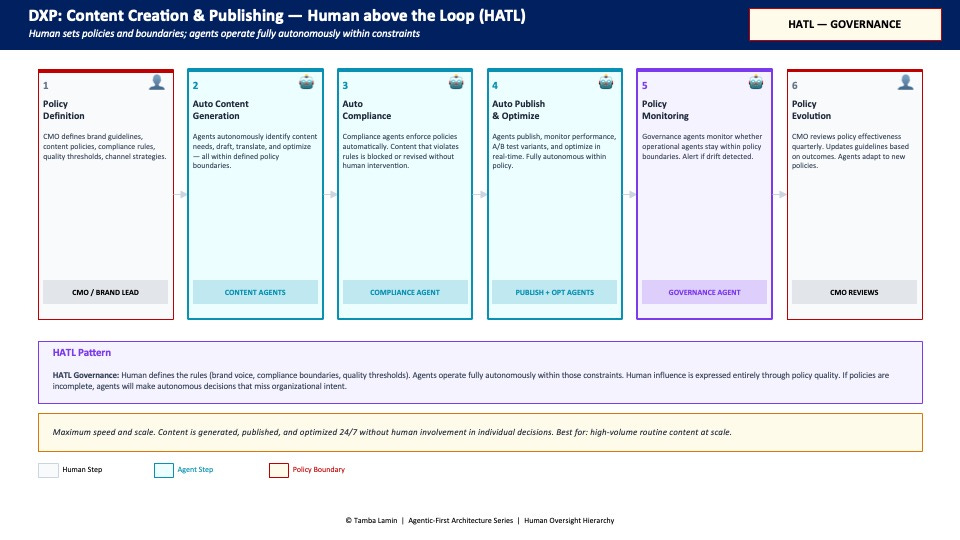
The human is above the loop — setting the policies, rules, boundaries, and objectives within which agents operate autonomously. The human governs the system’s behavior through the constraints they define rather than participating in or supervising individual decisions.
In an Agentic-First system, HATL means the Chief Risk Officer defines the risk tolerance parameters and compliance boundaries within which procurement agents operate. The CIO establishes data governance policies that all agents must follow. The Chief Marketing Officer sets brand guidelines and content standards that content generation agents must adhere to. The agents then operate autonomously within these constraints, making thousands of individual decisions without any human approval or supervision of specific actions.
HATL represents the most mature governance model — the target state for Tier 3 (Constrained Autonomy) in the maturity model. But it is also the model with the highest governance risk: the human influence is expressed entirely through the policies they define. If those policies are incomplete, ambiguous, contradictory, or poorly enforced, agents will make autonomous decisions that diverge from organizational intent — and there is no human in or on the loop to catch them in real time.
The critical governance investment for HATL is policy quality and enforcement: comprehensive policy definition that covers edge cases and boundary conditions, automated policy testing (can the agent violate the policy in plausible scenarios?), continuous policy monitoring (are agents actually operating within the defined boundaries?), and regular policy review cycles that update constraints as business conditions, risk profiles, and regulatory requirements evolve.
Human in the Lead: The Layer That Most Frameworks Miss
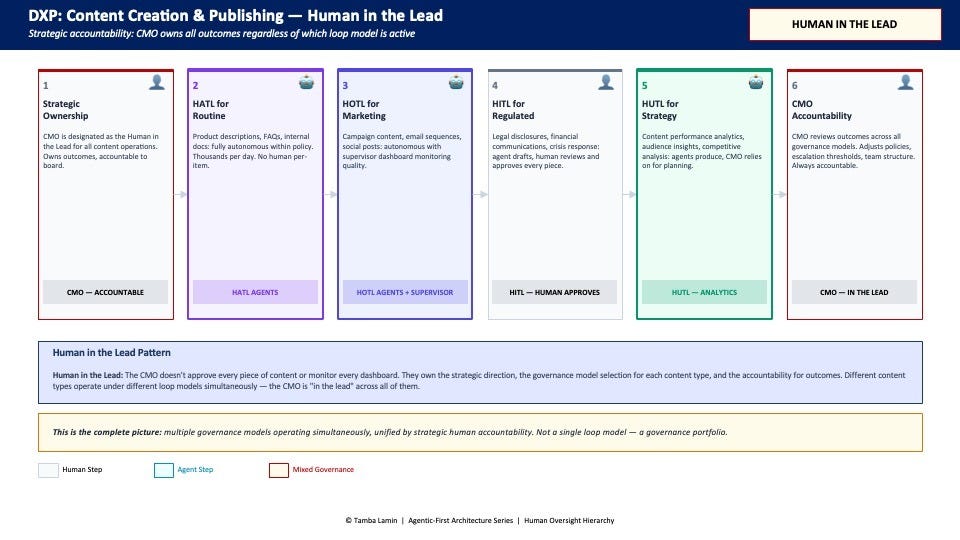
Now, here is where the framework becomes distinctive — and where most discussions of AI governance fall critically short.
“Human in the Lead” is a separate governance concept. It is not part of the loop taxonomy. It addresses a fundamentally different question: not where the human sits relative to the automated process, but who owns the decision and bears accountability for the outcomes?
The four-loop models describe the human’s operational relationship to the automated decision loop. Human in the Lead describes strategic authority. These are orthogonal dimensions of governance, and conflating them — or omitting the strategic dimension entirely — leads to governance architectures that are operationally detailed but strategically vacant. Every agent has a loop model. But who answers to the board when the agents collectively produce an outcome that damages the organization?
Human in the Lead means that for every domain in which agents operate, a designated human leader retains strategic accountability: they own the strategic objectives, define what success looks like, bear the accountability for outcomes, and retain the authority to change, override, or shut down the system at any level of autonomy.
In practice, a Chief Supply Chain Officer is “in the lead” of the supply chain agent ecosystem. The agents may operate under HATL governance at the tactical level (autonomous within defined policies), but the CSCO is “in the lead” at the strategic level — accountable to the board, regulators, and the organization for what the agents do and the outcomes they produce.
This is why the hybrid variations — “Human on the Lead,” “Human under the Lead,” “Human above the Lead” — don’t exist and shouldn’t. They would be conceptually meaningless. “Lead” refers to decision authority and accountability, not loop position. You are either in the lead — strategically accountable — or you are not. There is no “on the lead” because accountability is not a supervisory posture. There is no “above the lead” because there is no higher governance layer than decision ownership. These hybrid terms have no basis in control theory, no foundation in regulatory frameworks, and no utility in architectural design.
AI governance standards consistently rely on the established loop-based taxonomy for operational oversight, paired with clear accountability frameworks for strategic authority. The NIST AI Risk Management Framework, the OECD AI Principles, the EU AI Act, and ISO/IEC AI governance standards all use this structure — and so should enterprise architects.
The Complete Human Oversight Hierarchy
The five levels form a coherent hierarchy from strategic authority down to operational reliance:

This is the governance equivalent of the reference architecture from Article 4. It is the “poster on the wall” for oversight — the framework that every conversation about agent autonomy should reference.
Three critical observations about this hierarchy:
First, it is not a ladder you climb from bottom to top. Different agents in the same organization — even different actions by the same agent — may operate at different levels simultaneously. A procurement agent might use HITL for purchases above $100,000, HOTL for purchases between $10,000 and $100,000, and HATL for routine reorders below $10,000. The governance architecture must support this granularity. Building for one uniform oversight level across all agent actions means either over-restricting low-risk actions (killing the value proposition) or under-governing high-risk actions (creating unacceptable exposure).
Second, Human in the Lead applies across all maturity tiers, not just Tier 3. Even when agents operate with HITL approval in Tier 1, a human must be “in the lead” — strategically accountable for the decision to deploy agents in that domain, for the use cases selected, for the governance model chosen, and for the outcomes produced. Strategic accountability does not begin at autonomy. It begins at deployment.
Third, the hierarchy maps directly to the reference architecture from Article 4. Human in the Lead is the strategic governance layer. HATL is enforced through the policy engine in the Agent Layer. HOTL requires the observability infrastructure in the Infrastructure Layer. HITL requires the approval workflow surfaces in the Experience Layer. HUTL requires output-quality monitoring in the Data & Context Layer. The Security & Identity cross-cutting layer underpins all of them — you cannot govern an agent whose identity, permissions, and actions are not traceable.
The Regulatory Landscape: This Is Not Theory
The Human Oversight Hierarchy is not an abstract intellectual exercise. It maps directly to the regulatory frameworks that are now enforceable.
The NIST AI Risk Management Framework — which the agency released in January 2023 and which has since appeared in executive orders, state AI laws, and federal procurement requirements — structures AI governance around four functions: Govern, Map, Measure, and Manage. The Governance function emphasizes accountability structures and oversight mechanisms that directly parallel Human in the Lead (accountability) and the loop-based models (operational oversight). In February 2026, NIST launched its AI Agent Standards Initiative, which explicitly addresses agent identity, authorization, audit logging, and governance controls for autonomous systems. The initiative’s concept paper on AI Agent Identity and Authorization examines how existing standards like OAuth and OpenID Connect apply to agents that operate continuously and access multiple systems — a direct operationalization of the Security & Identity cross-cutting layer in the reference architecture. NIST’s track record suggests these voluntary guidelines will appear in compliance frameworks, vendor questionnaires, and procurement requirements within 18 months.
The EU AI Act, whose high-risk system requirements become enforceable in August 2026, mandates that high-risk AI systems be designed with effective human oversight. Article 14 requires that oversight measures be “commensurate with the risks, level of autonomy and context of use” — language that maps precisely to the graduated levels of the Human Oversight Hierarchy. Article 26 requires deployers to assign human oversight to individuals with “the necessary competence, training, and authority.” This is Human in the Lead — not just monitoring, but designated accountability with real authority.
The OECD AI Principles call for AI systems that are transparent, explainable, and subject to appropriate human oversight — with “appropriate” explicitly varying by risk level. The hierarchy provides the structured framework for determining what “appropriate” means for each use case.
ISO/IEC AI governance standards consistently use loop-based terminology in frameworks for human oversight of automated systems, providing an international standardization foundation for the hierarchy.
Accenture’s Technology Vision 2025 grounds the urgency in enterprise data: 77% of executives believe the true benefits of AI will only be possible when built on a foundation of trust, and 81% agree that trust strategies must evolve in parallel with technology strategy. The Human Oversight Hierarchy is how you operationalize that trust — systematically, proportionally, and in alignment with regulatory requirements that are no longer theoretical.
Applying the Hierarchy: Practical Governance Architecture
If you are designing governance for an Agentic-First system, here is how to apply this framework:
Define the oversight level for each agent action, not just for each agent. Build your governance architecture to support action-level granularity. A content agent might use HATL for internal draft generation, HOTL for routine customer communications, and HITL for public statements on regulated topics — all within the same agent. The orchestration layer in the reference architecture enforces this through escalation logic that routes decisions to the appropriate oversight model based on action type, confidence level, risk score, and policy triggers.
Designate a Human in the Lead for every agent domain from day one. Even for your first Tier 1 pilot, name a human leader who owns the strategic accountability. This is not bureaucracy — it is the accountability structure that regulators expect, and that builds the organizational trust you need to progress to higher autonomy levels. When NIST’s AI Agent Standards Initiative eventually produces compliance frameworks, accountability structures will be the first thing auditors look for.
Design your escalation architecture before you need it. The paths from HATL to HOTL to HITL must be built proactively into the orchestration layer. When an agent encounters a situation that exceeds its autonomous authority — a confidence score below threshold, a risk flag triggered, a novel situation with no policy precedent — the escalation must be seamless and fast. Escalation designed during an incident is not escalation. It is crisis management.
Match your infrastructure investment to your governance model. HITL requires approval workflow UIs and decision queues. HOTL requires real-time observability dashboards and anomaly detection. HATL requires comprehensive policy engines and automated policy testing. HUTL requires output quality monitoring and bias detection. Build the infrastructure your governance model demands — not more, not less.
Use the hierarchy as a communication tool. When your CISO asks, “How much autonomy do these agents have?” — the hierarchy gives a precise, structured answer. When the board asks, “Who is accountable?” — Human in the Lead gives a clear answer. When regulators ask “what safeguards are in place?” — the loop models map directly to their frameworks. Governance language that is precise enough for architecture is precise enough for boardrooms, audit committees, and regulatory submissions.
The Honest Gaps
No governance framework is complete, and intellectual honesty requires acknowledging the areas where the hierarchy has limitations:
The boundary between HOTL and HATL is often blurry in practice. When does a supervisor monitoring agent behavior cross from “on the loop” (active supervision) to “above the loop” (policy governance)? In a real deployment, the same person might shift between these modes depending on the situation, workload, and trust level. The hierarchy provides clean conceptual categories; reality is messier.
HUTL is the most architecturally underserved model. Most governance infrastructure focuses on HITL (approval) and HOTL (monitoring). Far less investment goes into the output quality assurance, bias detection, and calibration infrastructure that HUTL demands. This is a significant gap because HUTL scenarios — in which humans make high-stakes decisions based on agent-generated analysis — may pose the highest real-world risk of any governance model.
Human in the Lead requires organizational maturity that many enterprises lack. Designating strategic accountability is straightforward on paper. Making it operationally real — ensuring the designated leader has the authority, information, tools, and organizational support to exercise strategic oversight — requires governance structures that many enterprises have not yet built for AI.
Oversight fatigue is real and architecturally unaddressed. A human supervisor in a HOTL model who monitors hundreds of agent decisions per hour will inevitably develop alert fatigue. The governance model assumes attentive supervision; in reality, humans under cognitive load become unreliable supervisors. This is a known challenge from air traffic control, nuclear plant monitoring, and medical alarm fatigue — and the agentic era will reproduce it at scale.
These gaps do not invalidate the hierarchy. They define the research and engineering frontier — the problems the next generation of governance architecture needs to solve.
What This Means for Your Governance Strategy
The Human Oversight Hierarchy doesn’t constrain your agents. It is what makes their autonomy possible. Because the foundational truth of Agentic-First Architecture has been the same since Article 1: systems will only ever be as autonomous as they are trustworthy. And trust requires governance that is structured, proportional, and precisely defined.
The hierarchy gives you that structure. The reference architecture provides the layers for implementing it. The maturity model provides a path to grow into it. And the regulatory landscape — NIST, EU AI Act, OECD, ISO — gives you the urgency to start now.
This is the fifth article in my Agentic-First Architecture series. Article 1 introduced the paradigm. Articles 2 and 3 defined the protocol stack (MCP + A2A). Article 4 published the reference architecture. Article 6 will address LLM selection for agentic systems - how to choose the right model when agents, not humans, are the primary consumers. All previous articles are available on my Substack.
I’d welcome feedback from fellow architects and governance leaders: how are you defining oversight models for your agentic deployments? Is the loop terminology resonating in your board conversations? What governance infrastructure investments are you prioritizing?
#ResponsibleAI #AIGovernance #HITL #AgenticAI #EnterpriseArchitecture #AgentFirstArchitecture #HumanInTheLoop