

For the past decade, the enterprise technology playbook has been simple: move everything to the cloud. Cloud-native. Cloud-first. If it can run in the cloud, it should. The economic arguments were compelling (elastic scaling, operational simplicity, pay-as-you-go pricing), and the architectural arguments were even more so. Cloud was where innovation happened.
That assumption is breaking under the weight of agentic AI.
Not because the cloud is wrong. Cloud is exactly right for many agentic workloads. But agentic systems introduce three forces that the “cloud-everything” playbook wasn’t designed to handle: continuous inference economics that make API-based pricing unsustainable at scale, latency requirements that physics won’t let you solve from a centralized data center, and data sovereignty demands that regulation won’t let you ignore, regardless of how secure the cloud is.
The result is what I call the Great Rebalancing: a fundamental shift from “cloud-first” to “cloud-right.” Not cloud versus on-prem versus edge, but a deliberate, workload-driven topology where the question isn’t “can this run in the cloud?” but “where should this run to optimize for cost, latency, sovereignty, and resilience?”
This is the infrastructure article that completes the architectural stack. In the reference architecture (Article 4), the Infrastructure Layer is where everything physically runs. In the LLM selection article (Article 6), I introduced cloud, on-prem, and edge as deployment topologies. In the data architecture article (Article 7), I showed how data gravity shapes where agents should live. This article brings it all together into an infrastructure strategy for the agentic era.
Why Agentic Systems Break the Cloud-First Assumption
Traditional enterprise applications are request-response systems: a user clicks, a server processes, and a result returns. Usage is human-paced, bounded by how fast people type, click, and read. Cloud pricing works beautifully for this pattern because consumption is directly tied to human activity, which has natural limits.
Agentic systems are different in three fundamental ways:
Continuous inference, not sporadic requests. Agents don’t wait for humans to click. They operate continuously: monitoring event streams, processing decisions, coordinating with other agents, and executing workflows. A procurement agent monitoring inventory levels and supplier performance runs 24 hours a day, 7 days a week. A compliance agent scanning transactions for policy violations processes without pause. This always-on pattern turns cloud API pricing from a convenience into a cost crisis. Some enterprises are already seeing monthly AI compute bills in the tens of millions of dollars, with agentic AI’s continuous inference as the biggest cost contributor.
Latency-sensitive decision chains. In a chatbot, a 3-second response time is acceptable; the human waits. In an agentic workflow, latency compounds across every model call in the chain. An agent making 15 model calls to complete a task at 2 seconds per call produces a total workflow time of 30 seconds. For real-time use cases (fraud detection, dynamic pricing, manufacturing quality control, clinical decision support), this is unacceptable. The physical distance between the agent and the inference endpoint matters, and for many real-time workloads, that distance needs to be zero: the agent and the model must run on the same network, or even on the same device.
Data sovereignty is a hard constraint. The EU AI Act, HIPAA, financial services regulations, and government security requirements increasingly scrutinize not only where data is stored but also where AI inference occurs. A healthcare agent processing patient records, a financial agent analyzing transaction data, a government agent handling classified information: for these workloads, data sovereignty isn’t a preference. It’s a legal requirement that no cloud security certification can override.
These three forces don’t eliminate the cloud. They create gravitational fields that pull specific agentic workloads toward on-prem or edge deployment. The architectural challenge is determining which workloads belong where, and building the infrastructure topology that supports all three simultaneously.
The Three-Tier Hybrid Model
The industry is converging on a three-tier hybrid model that maps workload characteristics to deployment topology. This is the model I use with clients as a Reinvention Deployed Engineer at Accenture Song, and it’s consistent with how AWS, Google Cloud, and Microsoft Azure are all evolving their infrastructure offerings; each now provides not just cloud, but managed on-premises and edge deployment options that extend their platforms beyond the data center.
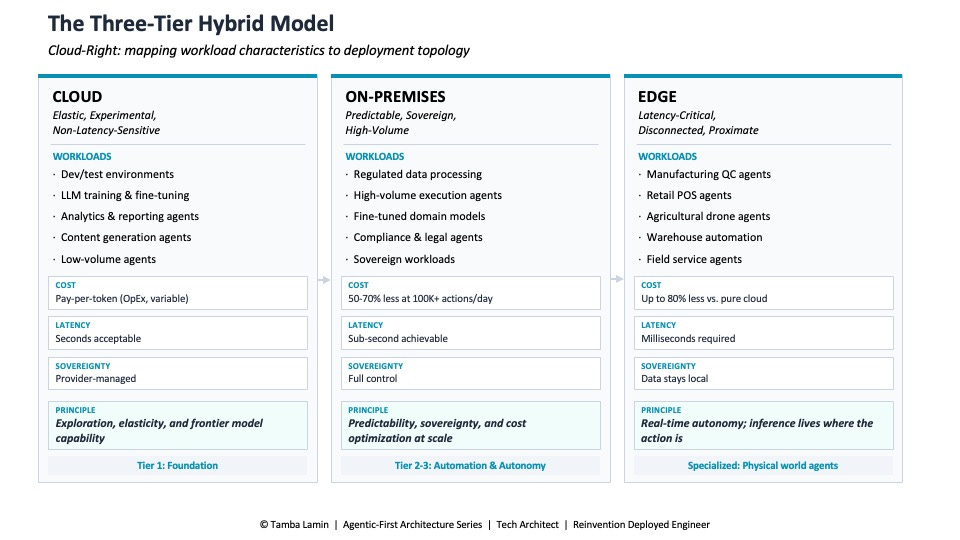
Tier 1: Cloud (Elastic, Experimental, and Non-Latency-Sensitive)
Cloud remains the right deployment for agentic workloads that are elastic (volume varies significantly), experimental (you’re still iterating on the agent design), or non-latency-sensitive (seconds of response time are acceptable).
This includes agent development and testing environments, LLM training and fine-tuning workloads, analytics and reporting agents that process data in batch or near-real-time, content generation agents where a 2-3 second response is acceptable, and low-volume agents where the API cost doesn’t justify infrastructure investment.
Cloud is also the fastest path from idea to production. For Tier 1 (Foundation) maturity deployments from the reference architecture, the cloud should be the default. You don’t yet know your production workload patterns. You need the elasticity to experiment. And the operational simplicity of calling an API lets your team focus on agent design rather than infrastructure management.
The cloud tier also serves as the frontier model tier, where the most capable reasoning models live. As discussed in Article 6, frontier models require GPU infrastructure that most enterprises don’t want to own. Cloud API access to frontier models is a permanent part of most model fleets, even for organizations that self-host their execution-tier models.
The architectural principle: cloud is for exploration, elasticity, and frontier capability. Start here. Graduate workloads to other tiers as patterns emerge.
Tier 2: On-Premises (Predictable, Sovereign, and High-Volume)
On-premises deployment becomes the economically rational choice when agentic workloads are predictable (consistent volume, well-understood resource requirements), sovereignty-constrained (data cannot leave the premises), or high-volume (the sustained cost of cloud API calls exceeds the amortized cost of owned infrastructure).
The tipping point for cost is real and quantifiable. When cloud costs begin to exceed 60-70% of the total cost of acquiring equivalent on-premises systems, capital investment becomes more attractive than operational expenses for predictable AI workloads. For organizations running more than 100,000 agent actions per day with consistent volume, the annualized cost of self-hosted inference is typically 50-70% less than equivalent cloud API costs.
On-premises is the natural home for agents processing sensitive data in regulated industries: healthcare agents handling patient records, financial agents analyzing transaction data, government agents processing classified information, and legal agents working with privileged communications. For these workloads, on-prem isn’t a cost optimization. It’s a compliance requirement.
The on-prem tier also enables model customization that cloud APIs don’t support. Fine-tuned open-source models running on owned infrastructure can deliver tool-calling reliability that exceeds general-purpose enterprise models on specific domain tasks, because they are trained on your tool schemas, data formats, and domain vocabulary. This maps to the open-source model strategy from Article 6: enterprise models in the cloud for capability ceiling, fine-tuned open-source models on-prem for specialized, high-volume execution.
The operational burden is real: GPU procurement and management, model serving infrastructure (quantization, batching, caching), cooling and power, ML engineering expertise, and a process for model updates. The emerging pattern to manage this complexity is the sovereign AI platform: purpose-built infrastructure that packages compute, storage, networking, and the agentic AI software stack into deployable units. Hyperscaler-managed on-prem offerings (Google Distributed Cloud, Azure Arc, AWS Outposts) reduce the operational barrier by extending cloud management planes to on-premises hardware, but still require more infrastructure expertise than pure cloud API consumption.
The architectural principle: on-prem is for predictability, sovereignty, and cost optimization at scale. The data doesn’t move to the compute; the compute moves to the data.
Tier 3: Edge (Latency-Critical, Disconnected, and Physically Proximate)
Edge deployment is for agentic workloads that must operate at the speed of physics, where the round-trip time to a cloud data center or even an on-premises server room is too slow for the decision the agent needs to make.
Manufacturing quality control agents inspecting products on a production line need to make inferences in milliseconds, not seconds. Retail agents detecting anomalies at the point of sale need to operate locally, independent of network reliability. Agricultural drone agents identifying crop disease need to process camera feeds mid-flight. Warehouse automation agents coordinating robotic systems need to make real-time decisions without relying on the network.
Edge deployment uses smaller, optimized models (typically quantized versions of mid-tier or open-source models compressed for constrained hardware) that sacrifice some capability for the latency and autonomy advantages of local execution. Research demonstrates that hybrid edge-cloud architectures for agentic AI workloads can achieve energy savings of up to 75% and cost reductions exceeding 80% compared to pure cloud processing, because edge processing leverages local context and avoids the energy demands of cloud-scale systems.
The edge tier is also the operational resilience tier. Edge agents continue operating during network outages, a critical requirement for manufacturing, healthcare, and field operations, where an internet outage cannot be allowed to halt operations. Self-healing edge infrastructure, where AI agents autonomously restart services, reroute traffic, or isolate faulty sensors, is emerging as a pattern for mission-critical deployments.
The architectural pattern for edge is “split inference,” where early model layers process locally for speed and privacy, while complex reasoning escalates to on-prem or cloud resources when network connectivity allows. This creates a graduated response pattern: simple decisions happen at the edge in milliseconds, complex decisions escalate to more capable infrastructure, and all decisions are logged and synchronized when connectivity is available.
The architectural principle: edge is for real-time autonomy. When the speed of the decision must match the speed of the physical world, the inference must live where the action is.
Agent Topology: A New Architectural Discipline
The three-tier model raises a new architectural question that didn’t exist in traditional enterprise computing: which agents run where?
I call this agent topology: the discipline of mapping agents to deployment tiers based on their workload characteristics, data requirements, latency constraints, governance models, and cost profiles. Agent topology is to Agentic-First architecture what data topology is to microservices; it’s the infrastructure decision that determines whether the system performs, complies, and scales.
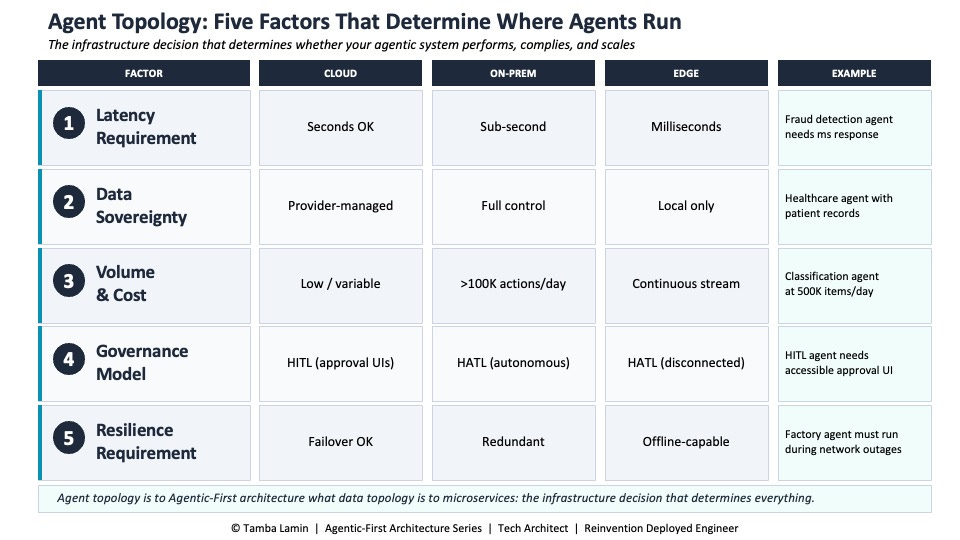
Agent topology decisions are driven by five factors:
Latency requirement. Agents that must respond in milliseconds run at the edge. Agents that can tolerate seconds run in the cloud. Agents with sub-second requirements run on-prem. Map each agent’s response time requirement to the tier that can physically deliver it.
Data sovereignty. Agents processing sovereign data run on-prem or at the edge, wherever the data resides. The data doesn’t move to the agent; the agent moves to the data. This inverts the cloud assumption, where compute is centralized and data flows to it.
Volume and cost. High-volume agents with predictable workloads run on-prem, where the amortized infrastructure costs are lower. Low-volume or variable agents run in the cloud where elasticity prevents over-provisioning. Calculate the cost per agent action (Article 6) at each tier and route accordingly.
Governance model. The Human Oversight Hierarchy from Article 5 influences topology. HITL agents (human approves every action) often run in the cloud, where approval workflow UIs are most accessible. HATL agents (fully autonomous within their policies) may run on-prem or at the edge, operating without human interaction. HOTL agents need observability infrastructure in on-prem or cloud environments, with dashboards accessible.
Resilience requirement. Agents that must operate during network outages run at the edge. Agents that can tolerate brief downtime run in the cloud with failover. Mission-critical agents run on-prem with redundancy.
In practice, a single enterprise agentic system might span all three tiers simultaneously: orchestrator agents in the cloud (elastic, frontier model access, accessible to governance UIs), operational agents on-prem (high-volume, sovereign data, fine-tuned models), and edge agents in factories and field locations (real-time, disconnected-capable, quantized models). The MCP and A2A protocols in Articles 2 and 3 provide the communication fabric that connects agents across all three tiers, and the LLM gateway in Article 6 provides the model routing infrastructure that directs inference to the appropriate tier.
The MCP Bridge: Connecting Across Topologies
The most critical infrastructure pattern in a multi-tier agentic deployment is the MCP bridge, which enables agents on one tier to access data and tools on another.
An edge agent in a manufacturing facility needs to access the central ERP system for inventory data. A cloud-hosted orchestrator needs to invoke tools hosted on an on-premises MCP server that wraps a legacy database. An on-prem compliance agent needs to call a cloud-hosted frontier model for complex regulatory reasoning.
The MCP bridge provides secure, authenticated, protocol-compliant connections across tier boundaries. It handles network transit encryption (mTLS), authentication and authorization (OAuth 2.0/OIDC), data filtering (ensuring that only the minimum necessary data crosses boundaries), latency management (caching, connection pooling, request batching), and audit logging (every cross-tier access is logged for the Governance & Observability cross-cutting layer).
The agent gateway, an emerging standard in the Linux Foundation ecosystem, serves as the entry point for MCP and A2A traffic at each tier boundary. It enforces security policies, manages traffic routing, provides observability, and ensures that cross-tier agent communication meets the same governance standards as within-tier communication.
The Honest Gaps
Multi-tier operations are genuinely complex. Running agents across cloud, on-prem, and edge simultaneously creates operational challenges that few enterprises have solved at scale: model version synchronization across tiers, monitoring and alerting that spans multiple environments, incident response when the failing component is on a factory floor rather than in a data center, and development workflows that must test across all three deployment targets.
Edge AI infrastructure is still maturing. While the economic and latency arguments for edge deployment are compelling, the hardware ecosystem, deployment tooling, and management platforms are less mature than their cloud equivalents. The investment ecosystem is responding (AI compression platforms for edge devices, autonomous network AI for telecom edge, and NPU-first hardware designs are all accelerating), but enterprises deploying edge agents today are still often building custom operational tooling.
Cost modeling across tiers is difficult. Comparing the true cost of a cloud API call, an amortized on-prem inference, and an edge deployment requires accounting for infrastructure acquisition, power, cooling, personnel, maintenance, the opportunity cost of capital, and the operational overhead of multi-tier management. Most enterprises lack the financial models to make these comparisons accurately.
The “right place” for a workload changes over time. An agent that starts as a low-volume cloud experiment may grow into a high-volume on-prem workload as adoption scales. The topology must be dynamic, and the infrastructure must support migration between tiers without requiring agent rewrites. This is why model-agnostic agent design (Article 4) and the LLM gateway abstraction (Article 6) are architectural prerequisites for topology flexibility.
What This Means for Your Infrastructure Strategy
Start in the cloud. Migrate deliberately. Every agentic deployment should begin in the cloud; it’s the fastest path to production and the lowest operational barrier. As workloads mature, volumes stabilize, and cost patterns emerge, evaluate which agents should migrate to on-prem or edge based on the five topology factors.
Build for topology portability from day one. Your agent layer must be deployment-agnostic. Agents that are tightly coupled to a specific cloud provider’s runtime, a specific model’s API format, or a specific infrastructure stack cannot migrate when the topology changes. The model-agnostic, protocol-standardized architecture from Articles 2, 3, and 4 exists precisely to enable this portability.
Invest in the MCP bridge and agent gateway early. Cross-tier connectivity is the operational lifeline of a hybrid agentic system. If your cloud agents can’t securely access on-prem data, or your edge agents can’t escalate to cloud-hosted reasoning models, the multi-tier architecture provides no value. Build the bridge infrastructure before you need it.
Design agent topology as an architectural discipline. Don’t let topology decisions happen by default (“the developer used this cloud service, so the agent runs there”). Map each agent’s latency, sovereignty, volume, governance, and resilience requirements to the appropriate tier. Document the topology. Review it as workloads evolve.
Prepare for sovereign AI as a permanent requirement. Sovereign AI, where organizations maintain control over data, models, and infrastructure to meet security, governance, and compliance requirements, is not a temporary regulatory trend. It’s accelerating across every major jurisdiction. The organizations investing now in sovereign inference capability, not as a replacement for cloud but as a complement to it, will have a competitive advantage when sovereignty requirements expand to cover more data categories and more jurisdictions.
The Great Rebalancing is not a rejection of cloud. It’s the maturation of cloud, from the default answer for everything to the right answer for the workloads that suit it. Combined with on-premises infrastructure for sovereign, predictable, high-volume workloads and edge deployment for latency-critical, disconnected operations, the result is an infrastructure topology designed for how agentic systems actually behave, not for how traditional applications used to.
The question is no longer “cloud or on-prem?” It’s “which agents run where, why, and how do they connect?” That’s agent topology. And it’s the infrastructure discipline that will define the agentic era.
This is the eighth article in my Agentic-First Architecture series. Article 1 introduced the paradigm. Articles 2 and 3 defined the protocol stack (MCP + A2A). Article 4 published the reference architecture. Article 5 defined the Human Oversight Hierarchy. Article 6 addressed LLM selection. Article 7 covered data architecture. Article 9 will get hands-on, building a working Agentic-First system with open protocols and open-source tools.
I’d welcome feedback from infrastructure architects: how are you balancing cloud, on-prem, and edge for your agentic workloads? What tipping points have you encountered at what cost? Is sovereign AI driving your topology decisions?
#AgenticAI #CloudComputing #EdgeAI #EnterpriseArchitecture #InfrastructureStrategy #AgentFirstArchitecture