

In the first three articles of this series, I established the paradigm (Agentic-First Architecture), defined the vertical protocol (MCP — how agents connect to tools and data), and defined the horizontal protocol (A2A — how agents collaborate with each other).
A reference architecture isn’t a deployment diagram. It’s an architectural north star, the “poster on the wall” that every architect, every engineer, and every technology leader can point to when making decisions about where capabilities live, how they connect, what governs them, and how the system evolves. It’s the artifact I use as a Reinvention Deployed Engineer when I’m embedded with clients, the shared mental model that aligns technical teams, business stakeholders, and governance bodies around a common vision.
What follows is the Agentic-First Reference Architecture; six core layers plus two cross-cutting layers, a three-tier maturity model for progressive adoption, and a mapping to real enterprise platform landscapes.
The Agentic-First Reference Architecture: Six Core Layers + Two Cross-Cutting Layers
Every Agentic-First system, regardless of industry, scale, or technology stack, can be decomposed into six core architectural layers and two cross-cutting layers that span the entire stack. The six core layers handle the functional decomposition - from how users interact with the system down to where it physically runs. The two cross-cutting layers - Security & Identity, and Governance & Observability- are not stacked beneath the core layers. They wrap the entire architecture, because security and governance are active concerns that touch every layer simultaneously.
This distinction matters architecturally. Placing security at the bottom of a stack implies it’s the foundation infrastructure you build once and sit on top of. Making it cross-cutting communicates the real architectural truth: every layer has security responsibilities, every layer has governance responsibilities. This is how zero-trust architecture actually works, and it’s how responsible AI governance must work in an Agentic-First system.
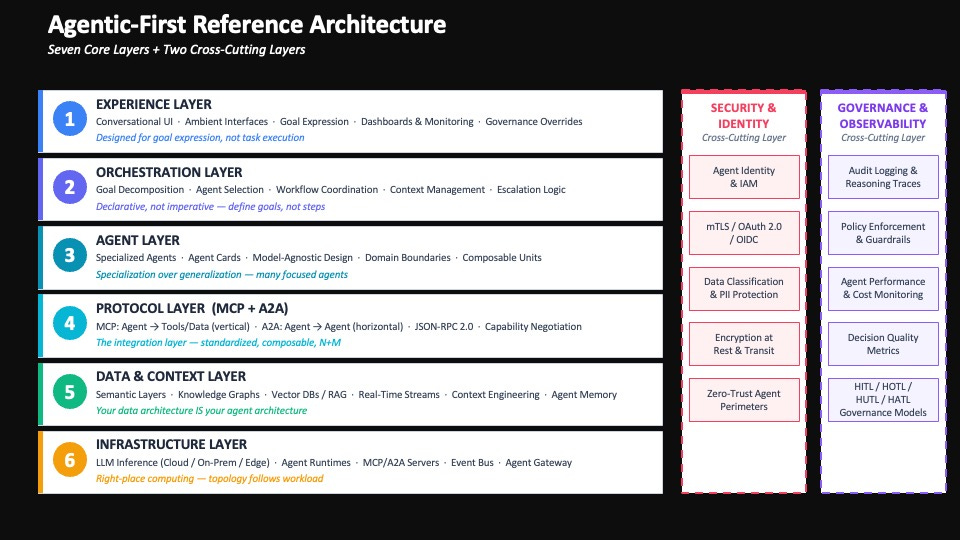
Layer 1: Experience Layer
This is where humans interact with the system. In traditional architecture, the experience layer is the primary interface: forms, dashboards, and navigation menus. In an Agentic-First architecture, the experience layer shifts from being the primary mode of interaction to being an oversight and governance interface.
The experience layer in an Agentic-First system includes conversational interfaces (natural language, chat, voice) through which users express intent rather than navigate menus; ambient interfaces that operate proactively without requiring user initiation; dashboard and monitoring surfaces where humans observe agent behavior, review decisions, and intervene when necessary; and traditional forms and workflows that persist as governance overrides for high-stakes decisions requiring explicit human approval.
The key architectural principle: the experience layer should be designed for goal expression, not task execution. A user says, “resolve this customer’s billing dispute” - they don’t click through seven screens to do it.
Layer 2: Orchestration Layer
The orchestration layer is the brain of the system; it decides which agents to invoke, in what sequence, with what context, and under what constraints. This is where intent gets translated into coordinated agent action.
The orchestration layer handles goal decomposition (breaking a high-level user intent into actionable sub-tasks), agent selection (choosing the right specialist agent for each sub-task based on capabilities, availability, and cost), workflow coordination (managing the sequence, parallelism, and dependencies between agent tasks), context management (ensuring each agent has the right information at the right time without flooding context windows), and escalation logic (determining when to escalate from autonomous agent execution to human oversight based on confidence thresholds, risk levels, or policy triggers).
In the InfoQ Agentic AI Architecture Framework, this layer implements five core workflow patterns: Prompt Chaining (sequential execution), Routing (conditional delegation), Parallelization (concurrent execution), Evaluator-Optimizer (quality feedback loops), and Orchestrator-Workers (hierarchical task distribution). A mature orchestration layer supports all five and selects dynamically based on the task.
The architectural principle: orchestration should be declarative, not imperative. You define the goal and constraints; the orchestration layer determines the plan. This is what distinguishes agent orchestration from traditional workflow automation.
Layer 3: Agent Layer
This is where the actual agents live, the autonomous entities that sense, reason, and act. Each agent has a specific domain or capability: a sales agent, a procurement agent, a compliance agent, a data analysis agent.
In this reference architecture, agents are designed as modular, composable units with clear capability boundaries. Each agent exposes its capabilities through a standardized interface, an A2A Agent Card that describes what it can do, how to reach it, and the authentication it requires. Internally, each agent has access to its own set of tools and data via MCP connections.
The architectural principle: design for specialization, not generalization. A network of specialized agents that collaborate via A2A will outperform a single monolithic agent that tries to handle everything. This mirrors the microservices insight from a decade ago, and it’s just as true for agents.
Critically, the agent layer should be model-agnostic. Different agents may use different LLMs based on their task requirements; a reasoning-heavy compliance agent might use a frontier model, while a high-volume data classification agent might use a smaller, faster, cheaper model. The architecture should support this heterogeneity rather than constrain it.
Layer 4: Protocol Layer (MCP + A2A)
This is the nervous system, the standardized communication infrastructure that enables everything above it to function. As I detailed in Articles 2 and 3, this layer comprises two complementary protocols.
MCP (vertical) connects agents downward to tools, data sources, and services. Each enterprise system, database, or API is exposed through an MCP server that advertises its capabilities (Tools, Resources, Prompts) and enables agents to discover and interact with them at runtime.
A2A (horizontal) connects agents laterally to other agents. Agent Cards enable discovery, Tasks enable collaboration, Messages enable negotiation, and Artifacts enable structured output exchange, all across vendor, framework, and organizational boundaries.
The architectural principle: the protocol layer is the integration layer. Every system-to-agent and agent-to-agent connection flows through standardized protocols. This is what transforms a collection of point integrations into composable infrastructure, and it’s why I’ve argued that MCP turns the N×M integration problem into N+M.
Layer 5: Data and Context Layer
This is the layer most architects underestimate, and most agentic deployments fail on. Agents are only as good as the data they reason over and the context in which they operate.
The data and context layer encompasses semantic layers and knowledge graphs that give agents meaning, not just data, understanding that “customer” in the CRM and “client” in the billing system refer to the same entity; vector databases and RAG (Retrieval-Augmented Generation) pipelines that give agents access to institutional knowledge, policy documents, historical decisions, best practices, compliance rules; real-time data streams and event buses that give agents current information, not yesterday’s batch export; context engineering infrastructure, the systematic design of what information agents receive, when, and in what format, optimized for the context window constraints of the underlying models; and agent memory, both short-term (within a conversation or task) and long-term (across interactions), enabling agents to learn and maintain continuity.
Accenture’s Technology Vision 2025 describes this as enabling enterprises to “create their own unique cognitive digital brains” through advancements in digitizing knowledge, AI models, and agentic systems. This is precisely what the data and context layer provides: the brain’s memory and knowledge base.
The architectural principle: your data architecture IS your agent architecture. Bad data doesn’t cause bad reports; it causes autonomous bad decisions at scale.
Layer 6: Infrastructure Layer
This is where agents physically execute the compute, storage, networking, and deployment infrastructure that hosts the entire system. In an Agentic-First architecture, the infrastructure layer introduces new considerations that traditional cloud-native architectures weren’t designed for.
The infrastructure layer includes LLM hosting and inference infrastructure (cloud API endpoints, self-hosted models, or edge inference depending on latency, cost, and data sovereignty requirements); agent runtime environments (the compute environments where agents execute, including container orchestration for scaling); MCP and A2A server hosting (the infrastructure that runs the protocol servers connecting agents to systems and to each other); event infrastructure (message brokers, event buses, and streaming platforms that enable the event-driven patterns agents depend on); and gateway infrastructure (API gateways and agent gateways that manage traffic, enforce policies, and provide observability, the Linux Foundation’s agentgateway project, supporting both MCP and A2A, is an emerging standard here).
The architectural principle: infrastructure topology should follow agent workload characteristics, not default assumptions. I’ll address this in depth in Article 8, where I’ll argue that the agentic era is forcing a rebalancing among cloud, on-premises, and edge deployments, which I call “right-place computing.”
Cross-Cutting Layer: Security and Identity
Security is not a foundation you build once and sit on top of. It’s an active, pervasive concern that touches every layer of the stack simultaneously, which is why it’s positioned as a cross-cutting layer.
The security and identity layer spans the entire architecture and includes agent identity and access management (every agent needs a verifiable identity, assigned roles, and granular permissions - just like human employees. This is the “treat agents as workforce members” principle from Article 1; (mutual TLS (mTLS) for encrypted agent-to-agent and agent-to-server communication; OAuth 2.0 and OpenID Connect for standardized authentication - both MCP and A2A protocols support these schemes natively; data classification and protection (agents must understand the sensitivity level of the data they access and handle it accordingly - PII, financial data, health records each require different handling); encryption at rest and in transit across all layers; and zero-trust agent perimeters (no agent is trusted by default, regardless of where it runs or who deployed it - every request is authenticated and authorized at every layer).
The architectural principle: agents are workforce members - they need identity, access controls, and accountability at every layer, not just at the perimeter. An agent without a verifiable identity and auditable permissions is an ungoverned agent, and ungoverned agents are the “shadow IT” of the agentic era.
Cross-Cutting Layer: Governance and Observability
Governance is the architectural mechanism that enables autonomy. Like security, it’s not a horizontal band at one level - it’s a cross-cutting concern that wraps and monitors every other layer.
The governance and observability layer includes audit logging and reasoning traces (comprehensive logs of every agent decision, including the reasoning chain, the data accessed, the tools invoked, and the outcome - this is essential for regulatory compliance and organizational trust); policy definition and enforcement (the rules that define what agents can and cannot do, enforced across the orchestration layer, the agent layer, and the protocol layer); observability and monitoring (real-time dashboards that show agent behavior, performance, cost, error rates, and anomalies - not just system uptime, but decision quality); human oversight mechanisms (the HITL, HOTL, HUTL, HATL, and Human in the Lead governance models that I detail in Article 5 - the spectrum of human involvement from approving every action to governing at the strategic level); and regulatory compliance automation (agents that monitor other agents for policy violations, bias, drift, or anomalous behavior - governance agents watching operational agents).
Accenture’s research underscores the urgency: 77% of executives believe the true benefits of AI will only be possible when built on a foundation of trust, and 81% agree that trust strategies must evolve in parallel with technology strategy. Governance is what operationalizes that trust.
The architectural principle: governance is not a constraint on autonomy - it’s the prerequisite for autonomy. Systems will only ever be as autonomous as they are trustworthy.
Why both Security and Governance are cross-cutting, not stacked: Security ensures every connection is authenticated, every data flow is encrypted, and every agent has a verifiable identity. Governance ensures that every agent operates within defined policies, that every decision is auditable, and that human oversight is proportional to risk. You can’t have governance without security, but security alone doesn’t give you governance. Together, they wrap the six core layers to ensure autonomous operation is safe, auditable, and trustworthy.
The Three-Tier Maturity Model: How to Get There
No enterprise should attempt to build a fully autonomous agentic system on day one. The InfoQ framework, validated by Bain and other analyst firms, establishes a three-tier progression that I’ve adapted for Agentic-First Architecture:
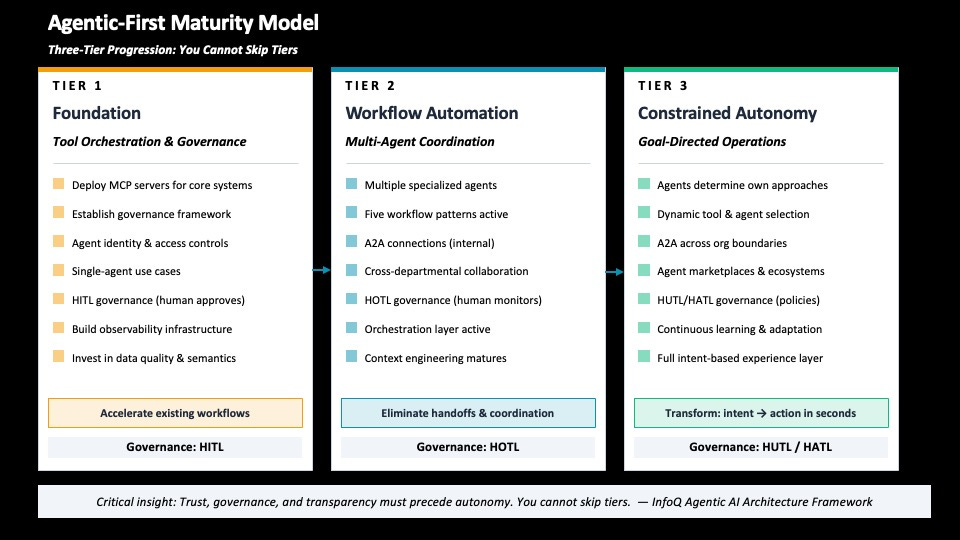
Tier 1: Foundation - Tool Orchestration & Governance
This is where every organization should start. The focus is on establishing the foundational capabilities that enable safe, scalable agent deployment.
In this tier, you deploy MCP servers for your core enterprise systems, exposing tools and data through standardized protocols. You establish the governance framework: agent identity management, access controls, audit logging, and policy enforcement. You implement single-agent use cases with strict HITL (Human-in-the-Loop) governance - every significant agent action requires human approval. You build the observability infrastructure to monitor agent behavior and track reasoning chains. And you invest heavily in data quality and semantic layers, because nothing else works without a solid data foundation.
The business value at this tier comes from accelerating existing workflows; agents retrieve information faster, draft responses for human review, and automate routine data operations. The architectural value comes from establishing the infrastructure and governance patterns that underpin everything else.
Tier 2: Workflow Automation - Multi-Agent Coordination
With the foundation in place, you progress to coordinated multi-agent workflows. This is where the orchestration layer becomes active, and A2A connections begin to emerge.
In this tier, you deploy multiple specialized agents that work together on complex tasks - a sales agent, a pricing agent, and a fulfillment agent, to process a customer request end-to-end. You implement the five workflow patterns (chaining, routing, parallelization, evaluator-optimizer, and orchestrator-workers) through the orchestration layer. You move from HITL to HOTL (Human-on-the-Loop) governance for proven, lower-risk workflows. Humans monitor agent behavior and can intervene, but don’t approve of every action. You expand A2A connections between agents within your organization and begin exploring cross-departmental agent collaboration.
The business value at this tier comes from eliminating handoffs, processes that previously required coordination across multiple teams now execute autonomously with human oversight. The architectural value comes from demonstrating that multi-agent coordination works in your environment and from refining orchestration patterns.
Tier 3: Constrained Autonomy - Goal-Directed Operations
This is the full Agentic-First paradigm in operation. Agents don’t just automate predefined workflows; they determine their own approaches, select their own tools, and collaborate dynamically to achieve goals.
In this tier, agents operate with significant autonomy within defined boundaries, which I call Constrained Autonomy Zones. These are domains where the agent has proven reliability, data quality is high, the governance framework is mature, and the organization has built trust through progression from Tier 1 to Tier 2. You move to HUTL (Human-under-the-Loop) or HATL (Human-above-the-Loop) governance models for mature domains, with humans setting policies and strategic direction and agents handling operational execution. You extend A2A collaboration across organizational boundaries, and your agents work with supplier, partner, and vendor agents through standardized protocols. And the experience layer fully shifts: users express goals, and agents determine how to achieve them.
The business value at this tier is transformational: the latency between intent and action collapses, cross-system intelligence becomes the default, and the organization operates at a speed and scale previously impossible. The architectural value is that the system is composable, extensible, and evolving; new agents can be added, new data sources can be connected, and new workflows can be created without rebuilding the foundation.
The critical insight: you cannot skip tiers. Organizations that rush to Tier 3 without establishing Tier 1 governance and Tier 2 workflow patterns will face cascading failures, regulatory exposure, and organizational resistance. As the InfoQ framework emphasizes, trust, governance, and transparency must precede autonomy.
Event-Driven Architecture: The Heartbeat of Agentic-First Systems
One architectural pattern deserves special attention because it underpins the entire reference architecture: event-driven architecture (EDA).
Traditional enterprise architectures are request-response: a user clicks a button, a system processes the request, and returns a result. Agentic-First systems are fundamentally event-driven: agents respond to events - a customer complaint filed, a shipment delayed, a compliance threshold breached, a market price change detected.
Event-driven architecture provides the real-time responsiveness that agents need. When an event occurs in one system, it’s published to an event bus and consumed by any agent that has subscribed to that event type. This eliminates polling, reduces latency, and enables the continuous, proactive operation that distinguishes agentic systems from traditional automation.
In the reference architecture, the event infrastructure sits in the infrastructure layer (Layer 6), but it connects upward through every layer. MCP servers can publish events when data changes. A2A agents can subscribe to events from other agents. The orchestration layer can trigger multi-agent workflows based on event patterns. And the governance layer can monitor event streams for policy violations.
If your current architecture is primarily request-response, investing in event-driven infrastructure (message brokers, event streaming platforms, event-sourced data patterns) is one of the highest-leverage preparations you can make for the agentic future.
Mapping the Reference Architecture to Enterprise Platform Landscapes
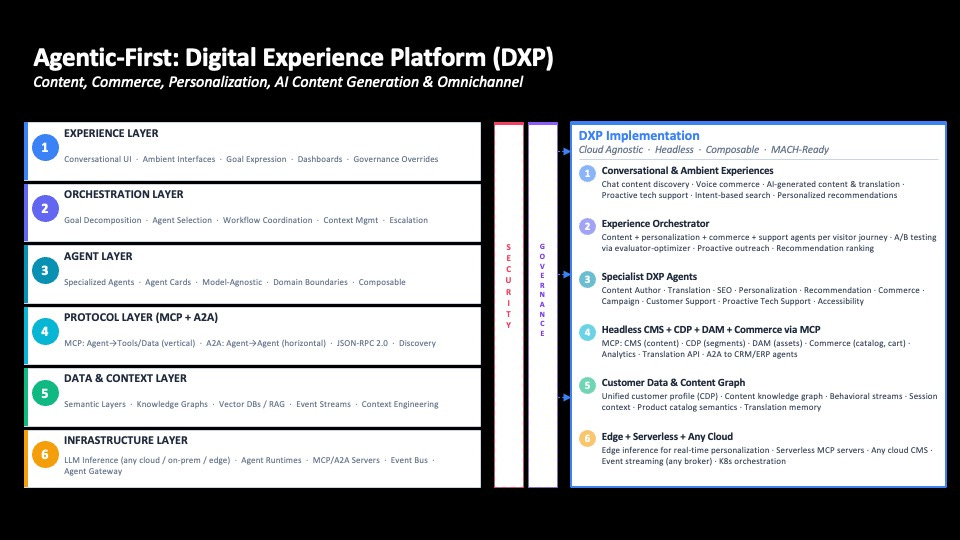
The reference architecture isn’t theoretical — it maps directly to how real enterprise platform ecosystems are structured. Let me show how the six core layers and two cross-cutting layers map to a typical enterprise landscape:
The Experience Layer maps to your existing CRM portal, employee self-service applications, customer-facing chatbots, and the new conversational and ambient interfaces that will progressively replace click-through navigation.
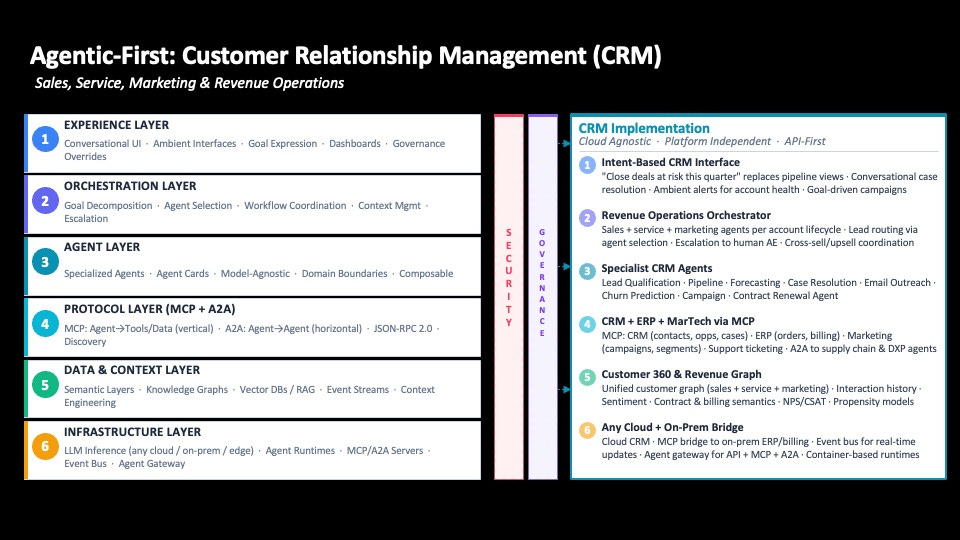
The Orchestration Layer maps to your integration and workflow platforms — but reimagined for agent coordination rather than deterministic process automation. This is where your existing iPaaS and workflow tools evolve to support agentic orchestration patterns.
The Agent Layer is new — this is where purpose-built agents live, each designed for a specific domain. Some will be vendor-provided (embedded in your CRM, ERP, or ITSM platform). Others will be custom-built for your proprietary processes. The best architectures will compose both.
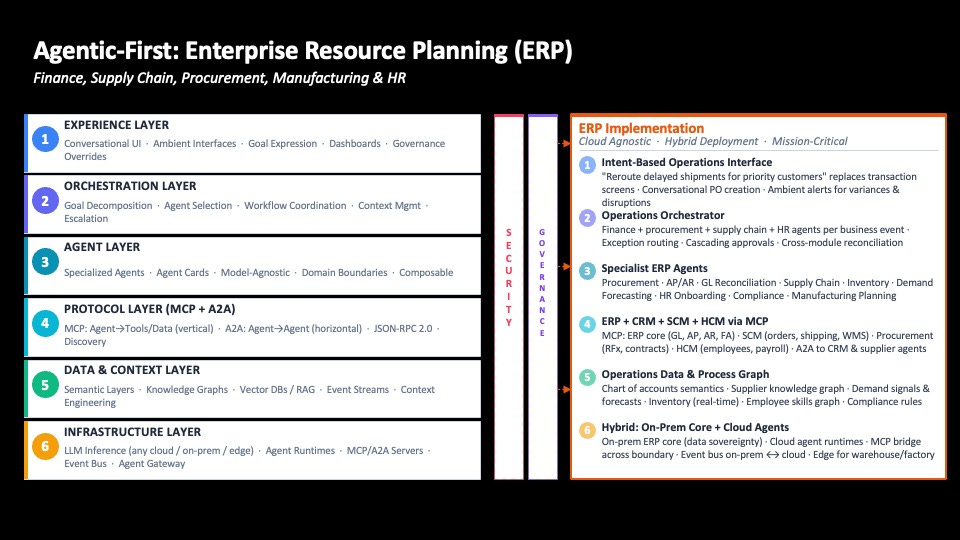
The Protocol Layer (MCP + A2A) maps to your current API management and integration infrastructure, but is extended with agent-native protocols. Your existing API gateways evolve to support MCP and A2A alongside REST and GraphQL.
The Data and Context Layer maps to your data platform, data lake, data warehouse, master data management, and the emerging semantic and knowledge graph infrastructure. This is the layer that requires the most investment for most enterprises, because agents demand higher data quality and richer context than traditional applications ever required.
The Infrastructure Layer maps to your cloud infrastructure, on-premises data centers, and emerging edge compute — the topic of Article 8.
The Security and Identity Layer (cross-cutting) maps to your existing IAM, zero-trust architecture, PKI, and encryption infrastructure, and is extended with agent-specific identity management, agent-to-agent mTLS, and protocol-level access controls for MCP and A2A connections. It touches every core layer: user authentication at Experience, authorization at Orchestration, agent identity at Agent, protocol security at Protocol, data classification at Data & Context, and network security at Infrastructure.
The Governance and Observability Layer (cross-cutting) maps to your existing compliance, audit, and monitoring infrastructure — extended with agent-specific capabilities like reasoning chain tracing, decision audit logging, policy-based agent behavior enforcement, and the Human Oversight Hierarchy from Article 5. It also touches every core layer: approval UIs at Experience, escalation logic at Orchestration, agent behavior monitoring at Agent, protocol audit at Protocol, data quality governance at Data & Context, and cost monitoring at Infrastructure.
What This Means for Your Strategy
If you take one thing from this article, let it be this: the reference architecture is a communication tool as much as a technical blueprint. It gives you a shared language to align your engineering teams, business stakeholders, security organization, and governance bodies around a common vision.
Here’s how I’d recommend using it:
Assess your current state against the six core layers and two cross-cutting layers. Where are you strong? Where are the gaps? Most organizations will find that the protocol layer (Layer 4) and the data and context layer (Layer 5) are their biggest gaps — exactly the layers that matter most for agentic systems. Many will also find that their security and governance layers are designed for human users rather than autonomous agents.
Start with Tier 1 maturity. Deploy MCP servers for your most important enterprise systems. Establish the governance framework. Build single-agent use cases with HITL oversight. Get the observability infrastructure in place. This is not the exciting part — but it’s the part that makes everything else possible.
Invest in event-driven infrastructure. If your architecture is primarily request-response today, this is one of the highest-leverage investments you can make. Agents need to respond to events in real time, not poll systems on schedules.
Use the architecture to drive vendor conversations. When evaluating platforms, map their capabilities to the six core layers and two cross-cutting layers. Where does the vendor cover? Where are the gaps? Which layers are you expected to build yourself? This framework turns vague “agentic capabilities” marketing into a structured capability assessment.
Build the right team. As I discussed in Article 1, deploying agentic systems requires cross-functional teams — Reinvention Deployed Engineers who reimagine processes with AI at the center, Forward Deployed Engineers who solve the hardest integration challenges, and deep industry and process SMEs who ensure the result works in the real world. Accenture has trained 30,000 professionals in this model specifically because the RDE approach — embedded engineers who understand both the architecture and the client’s operational reality — is how you translate a reference architecture into a working system.
The reference architecture is the north star. The maturity model is the path. The protocols are the plumbing. And the team is what makes it real.
This is the fourth article in my Agentic-First Architecture series. Article 1 introduced the paradigm. Articles 2 and 3 covered MCP and A2A — the protocol stack. Article 5 will address the governance spectrum in depth: HITL, HOTL, HUTL, and HATL - the models that determine how much autonomy your agents can have, and when.
I’d welcome feedback from fellow architects: does this reference architecture map to what you’re seeing in your environments? What layers would you add, modify, or challenge?
#AgenticAI #EnterpriseArchitecture #ReferenceArchitecture #MCP #A2A #DigitalTransformation #AgentFirstArchitecture