

In my previous article, I made the case for Agentic-First Architecture, the next paradigm shift after MACH, in which autonomous AI agents become the primary actors in enterprise systems, while traditional forms and workflows recede into governance layers.
If Agentic-First Architecture is the “what,” MCP is the “how.” And understanding why MCP matters, not just what it does, is essential for any technology leader, enterprise architect, or platform strategist thinking about the next decade of enterprise systems.
The Problem MCP Solves: The N×M Integration Nightmare
Before MCP, every AI agent needed custom connectors for every data source, tool, or service it interacted with. If you had 10 agents and 20 enterprise systems, you would need up to 200 custom integrations. Each has its own authentication model, data format, error handling, and maintenance burden.
This is the classic N×M integration problem, and it’s the exact problem that enterprise middleware, Enterprise Service Buses (ESBs), and Integration Platform as a Service (iPaaS) platforms have been solving (imperfectly) for decades. But AI agents introduce a new dimension: they don’t just need to read data; they also need to process it. They need to understand what tools are available, discover what those tools can do, reason about when to use them, and invoke them with the right parameters, all at runtime, often without pre-configuration.
Custom function-calling APIs and vendor-specific plugin frameworks attempted to solve pieces of this puzzle. But they were proprietary, brittle, and siloed. Each vendor’s approach locked agents into a single ecosystem. Interoperability was an afterthought.
MCP eliminates this with a single, universal, open protocol.
What MCP Actually Is: The Technical Foundation
MCP, the Model Context Protocol, is an open standard introduced by Anthropic in November 2024 that provides a universal interface for AI agents to connect to tools, data sources, and services. Think of it as the REST equivalent for the agentic era, but designed specifically for how AI agents discover, reason about, and interact with the world.
At the protocol level, MCP uses JSON-RPC 2.0, the same well-understood, widely implemented remote procedure call standard that underpins much of the modern web. This was a deliberate choice. By building on an established foundation rather than inventing something new, MCP inherits decades of tooling, debugging capability, and developer familiarity.
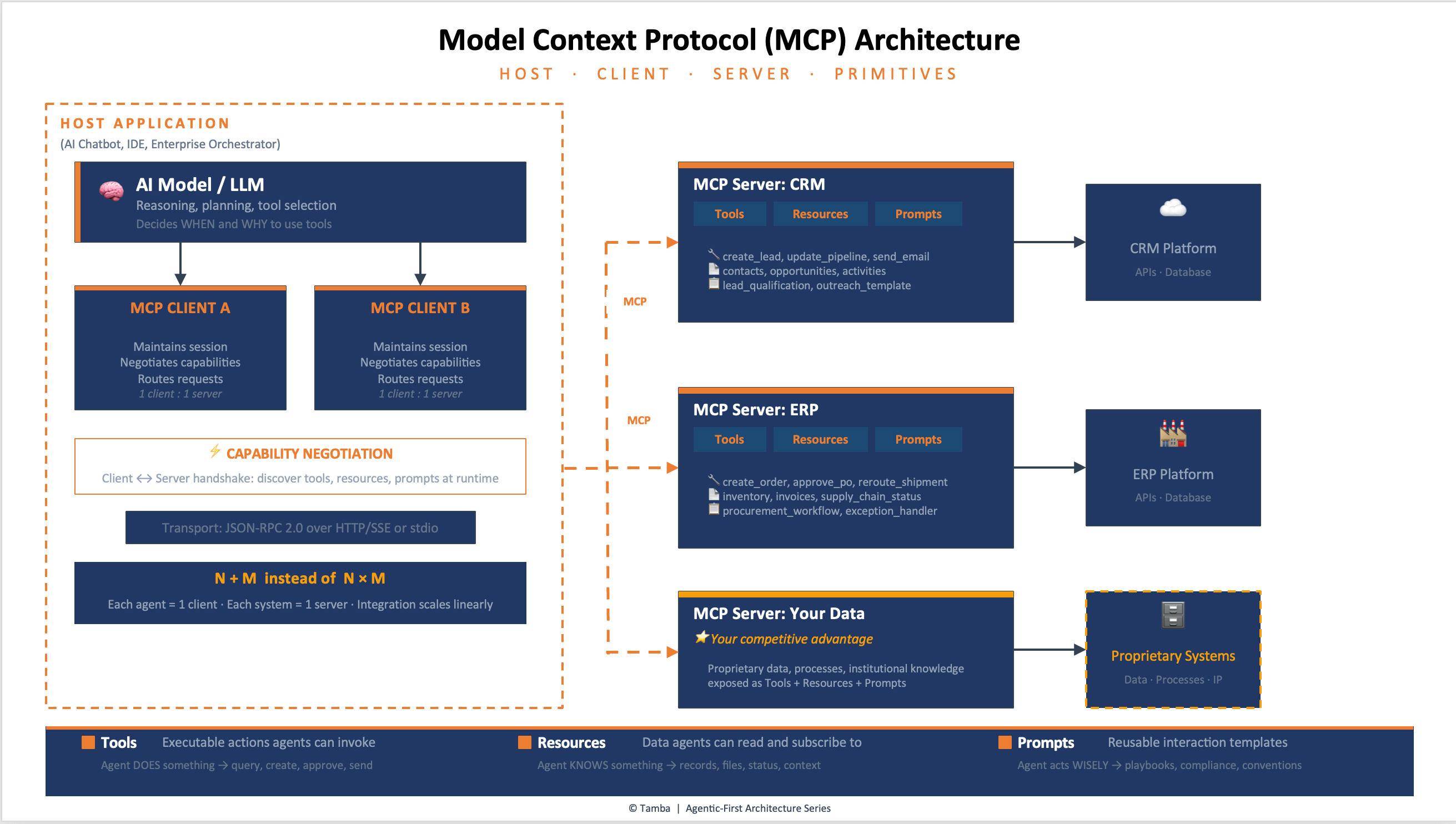
The architecture follows a Host-Client-Server model. The Host is the AI application (a chatbot, an IDE, an enterprise orchestrator). The Host embeds an MCP Client that manages connections. The Client communicates with MCP Servers, standalone programs that each expose a specific set of capabilities. One server might expose your CRM data. Another might expose your ERP actions. Another might expose your document repository. The agent, through the client, can discover and interact with all of them using a single consistent protocol.
The Three Primitives: Tools, Resources, and Prompts
MCP organizes everything agents need into three core primitives:
Tools are executable functions, actions the agent can take. Query a database. Send a notification. Create a record. Approve a request. Each tool is described using a machine-readable schema that specifies what the tool does, the parameters it requires, and what it returns. Critically, agents discover tools at runtime; they don’t need to be hardcoded in advance.
Resources are data that the agent can read, such as files, database records, API responses, and configuration data. Resources have URIs, can be subscribed to for real-time updates, and maintain context across interactions. This gives agents continuous awareness of the enterprise data landscape, not just point-in-time snapshots.
Prompts are reusable templates that help agents interact with tools and resources correctly, pre-configured interaction patterns that encode best practices, compliance requirements, or organizational conventions. Think of them as “agent playbooks” that can be shared across an organization.
This three-primitive model is elegant in its simplicity. Tools let agents act. Resources let agents know. Prompts let agents act wisely. Together, they give agents everything they need to operate autonomously within enterprise environments.
Capability Negotiation: The Handshake That Changes Everything
Here’s where MCP’s design becomes architecturally significant for Agentic-First systems. When a client connects to a server, the first step is capability negotiation - a handshake in which both sides advertise what they support. The server declares: “I offer these tools, these resources, these prompt templates.” The client declares: “I support sampling, I can handle root filesystem access, I can process notifications.”
This is fundamentally different from traditional API integration, where the client must already know the API’s endpoints, parameters, and authentication requirements before the first call. MCP inverts this - the agent discovers capabilities dynamically. This is what makes MCP the nervous system of Agentic-First Architecture. Agents don’t need to be pre-programmed with knowledge of every system they interact with. They discover, negotiate, and adapt at runtime.
In a truly Agentic-First platform, this means you can add a new enterprise system by deploying an MCP server, and every agent in the ecosystem immediately discovers and can interact with it. No reconfiguration. No redeployment. No new custom integration code.
Why MCP Matters for Agentic-First Architecture: Five Architectural Arguments
1. MCP Turns the N×M Problem into N+M
Without MCP, connecting N agents to M enterprise systems requires up to N×M custom integrations. With MCP, each agent implements one client, each system implements one server, and the total integration effort is N + M. This isn’t just an efficiency gain - it’s what makes enterprise-scale agentic systems practically buildable. As BCG noted in their analysis, without a standard protocol, integration complexity rises quadratically as agents spread across the enterprise. With MCP, it rises linearly.
2. MCP Makes Agents Composable
In MACH architectures, composability means assembling best-of-breed components through standardized APIs. MCP brings the same principle to the agentic layer. Because every MCP server exposes capabilities through the same protocol, agents can compose across them - pulling data from one server, invoking actions on another, and maintaining context throughout. This is the architectural prerequisite for cross-system intelligence, one of the key advantages of Agentic-First systems I outlined in my previous article.
3. MCP Enables Dynamic Discovery — Not Static Configuration
Traditional integrations are statically configured - you define the endpoint, the authentication, the schema, and you deploy. If anything changes, you reconfigure and redeploy. MCP’s runtime capability negotiation means agents discover what’s available dynamically. This is the difference between an architecture that requires human intervention for every new integration and one that allows agents to autonomously expand their operational reach.
4. MCP Provides the Governance Surface
For enterprise architects, one of the most compelling aspects of MCP is that it creates a standardized governance surface for agent behavior. Because all agent-to-system interactions flow through MCP, you have a single protocol layer where you can implement access controls, audit logging, rate limiting, consent management, and policy enforcement. Without a standard protocol, governing agent behavior across dozens of custom integrations becomes an exercise in chasing shadows. With MCP, governance becomes architectural - built into the infrastructure rather than bolted on after the fact.
5. MCP Prevents Vendor Lock-In at the Agent Layer
Before MCP, if you built your agentic capabilities on one vendor’s proprietary function-calling framework, you were locked in. Switching models or platforms meant rewriting every integration. Because MCP is an open standard - now governed by the Agentic AI Foundation under the Linux Foundation - your MCP server investments are portable across any AI model, any client, any platform that supports the protocol. OpenAI, Google DeepMind, Microsoft, AWS, and Anthropic all support MCP. This is the agent-layer equivalent of building on REST instead of a proprietary API.
The MCP Ecosystem: From Experiment to Infrastructure
The adoption velocity of MCP is unlike anything I’ve seen in enterprise protocol standards. Here are the milestones that matter:
November 2024: Anthropic launches MCP as an open-source standard. Initial SDK downloads are in the tens of thousands.
March 2025: OpenAI adopts MCP across its Agents SDK, Responses API, and ChatGPT desktop. Sam Altman’s public endorsement signals that this is not a single-vendor play.
April 2025: Google DeepMind confirms MCP support in Gemini models. The protocol now has backing from the three leading AI model providers.
November 2025: A major specification update adds asynchronous tasks, enhanced security (including OAuth improvements and client security requirements), server identity, and an official community-driven registry for discovering MCP servers. Monthly SDK downloads reach 97 million across Python and TypeScript.
December 2025: Anthropic donates MCP to the newly formed Agentic AI Foundation (AAIF) under the Linux Foundation. OpenAI and Block join as co-founders. AWS, Google, Microsoft, Cloudflare, and Bloomberg join as supporting members. The ecosystem now includes over 5,800 MCP servers and 300+ MCP clients.
The numbers are staggering. From approximately 100,000 downloads in November 2024 to over 8 million by April 2025, and approaching 100 million monthly SDK downloads by year-end. Major enterprise deployments at organizations across financial services, healthcare, retail, and technology. Forrester predicts 30% of enterprise application vendors will launch MCP servers in 2026.
This is not hype. This is infrastructure adoption at a pace that rivals the early days of REST.
MCP’s Honest Gaps: What Enterprise Architects Need to Watch
No protocol is perfect at version 1.0, and intellectual honesty requires acknowledging where MCP’s maturity still needs to catch up with its ambition:
Security shipped after interoperability. The earliest MCP implementations prioritized connecting agents. Authentication, authorization, and enterprise-grade security were addressed more fully in the November 2025 specification update, but many deployed servers still lack proper authentication. The risk of “Shadow Agents” - unauthorized agents accessing enterprise data through ungoverned MCP servers is real and growing.
Observability tooling is nascent. Monitoring agent behavior through MCP connections requires tracing reasoning chains, not just API call logs. While vendors are beginning to offer MCP monitoring, the observability ecosystem is still immature compared to what enterprises expect for mission-critical infrastructure.
Context window constraints. When an agent connects to many MCP servers simultaneously, the tool and resource descriptions consume context window capacity. At scale, this creates architectural tension between comprehensive capability discovery and model performance.
Regulatory frameworks haven’t caught up. MCP-powered agents making autonomous decisions across enterprise systems raise questions about accountability, audit trails, and regulatory compliance that existing frameworks weren’t designed to address.
These gaps are real, but they’re also the gaps that typically close rapidly once an ecosystem reaches critical mass. The trajectory is clear.
What This Means for Your Platform Strategy
If you’re an enterprise architect or technology leader, here’s how I’d think about MCP in the context of your platform roadmap:
Evaluate your current platforms for MCP readiness. Ask your CRM, DXP, CMS, ERP, ITSM, and HCM vendors: Do you have MCP servers? Are they in production or on the roadmap? If your vendor can’t articulate an MCP strategy, that’s a signal about how seriously they’re taking the agentic transition.
Start building MCP servers for your proprietary systems. The highest-value MCP servers aren’t the ones your vendors provide; they’re the ones that expose your organization’s unique data, processes, and institutional knowledge to agents. Your competitive advantage lives in your proprietary data and processes, not in generic platform capabilities.
Design your governance architecture around MCP. Because MCP standardizes agent-to-system communication, it becomes the natural control plane for agent governance. Invest in MCP gateways, registries, and monitoring before you scale agent deployments, not after.
Invest in MCP-literate engineering talent. The protocol is straightforward - JSON-RPC, TypeScript/Python SDKs, and a well-documented specification. But building production-grade MCP servers that handle enterprise security, scale, and reliability requires engineers who understand both the protocol and your enterprise environment. This is where the RDE and FDE models I discussed in my previous article become critical.
Don’t wait for perfection. MCP’s gaps are real, but its trajectory is unmistakable. The organizations building MCP competency now, even in imperfect early implementations, will have a structural advantage when the protocol matures. This is the same pattern we saw with REST, containerization, and cloud-native architectures. Early movers who built institutional knowledge during the maturation phase consistently outperformed those who waited for the “enterprise-ready” stamp.
The Bigger Picture: MCP as Architectural Infrastructure
Let me connect this back to the Agentic-First article.
Every major architectural paradigm shift has been enabled by a protocol layer that standardized how components communicate. HTTP and HTML enabled the web. REST enabled the API economy. GraphQL enabled flexible data access. MACH was made possible by the maturation of headless APIs and composable standards.
MCP is that protocol layer for the agentic era. It’s what makes Agentic-First Architecture practically buildable, not just theoretically desirable. Without MCP, every agentic deployment would be a custom integration project. With MCP, agentic capability becomes composable infrastructure.
The question for enterprise architects isn’t whether MCP will matter. The ecosystem has already answered that question. The question is whether you’ll be building on it or catching up to those who did.
This is the second article in my series on Agentic-First Architecture. The first article, “From Monolith to MACH to... What? The Case for Agentic-First Architecture,” is available on my Substack. I’d love to hear from architects and technology leaders who are already building with MCP in enterprise environments — what’s working, what’s not, and where you see the gaps.
#MCP #ModelContextProtocol #AgenticAI #EnterpriseArchitecture #AI #DigitalTransformation #AgentFirstArchitecture
Tamba, the timing of this article is spot on. The November 2025 MCP specification update provided important groundwork for decentralized trust through CIMD and stronger OAuth 2.1 integration, but the “honest gaps” you identified are where the real enterprise challenge begins.
From a cybersecurity standpoint, the transition from “Shadow Agents” to managed identities is still in its early stages at the deployment layer. Many organizations are moving toward protocol support, but far fewer are ready to enforce the security controls that matter operationally. The next phase of Agentic-First architecture will not be defined by connectivity alone, but by verifiable server identity, least-privilege execution, and strong local security guardrails.
Standardizing the plumbing was the first step. Establishing trust, governance, and control at scale is the real test.