

Enterprise technology architecture has followed a remarkably consistent evolutionary arc. We went from monoliths to service-oriented architecture. From SOA to microservices. From microservices to API-first. And from API-first to MACH (Microservices, API-first, Cloud-native, Headless) — the composable architecture philosophy that reshaped how we build Digital Experience Platforms, CMS, and Commerce systems.
Each transition followed the same pattern: what was once a secondary design concern became a first-class architectural citizen. APIs went from afterthoughts to the primary interface. Microservices went from decomposition strategies to the default unit of deployment. Cloud went from infrastructure choice to operational assumption.
Now we’re at the next inflection point. And I believe the equivalent paradigm shift for the AI era is what I call Agentic-First Architecture — systems designed from the ground up with autonomous AI agents as first-class citizens, where traditional forms-based and workflow-driven UIs become secondary interfaces, not the primary design surface.
What Is Agentic-First Architecture?
An Agentic-First system is one where the system architect builds with agents as the primary actors — not users filling out forms, clicking through menus, or following rigid workflow steps.
In this paradigm:
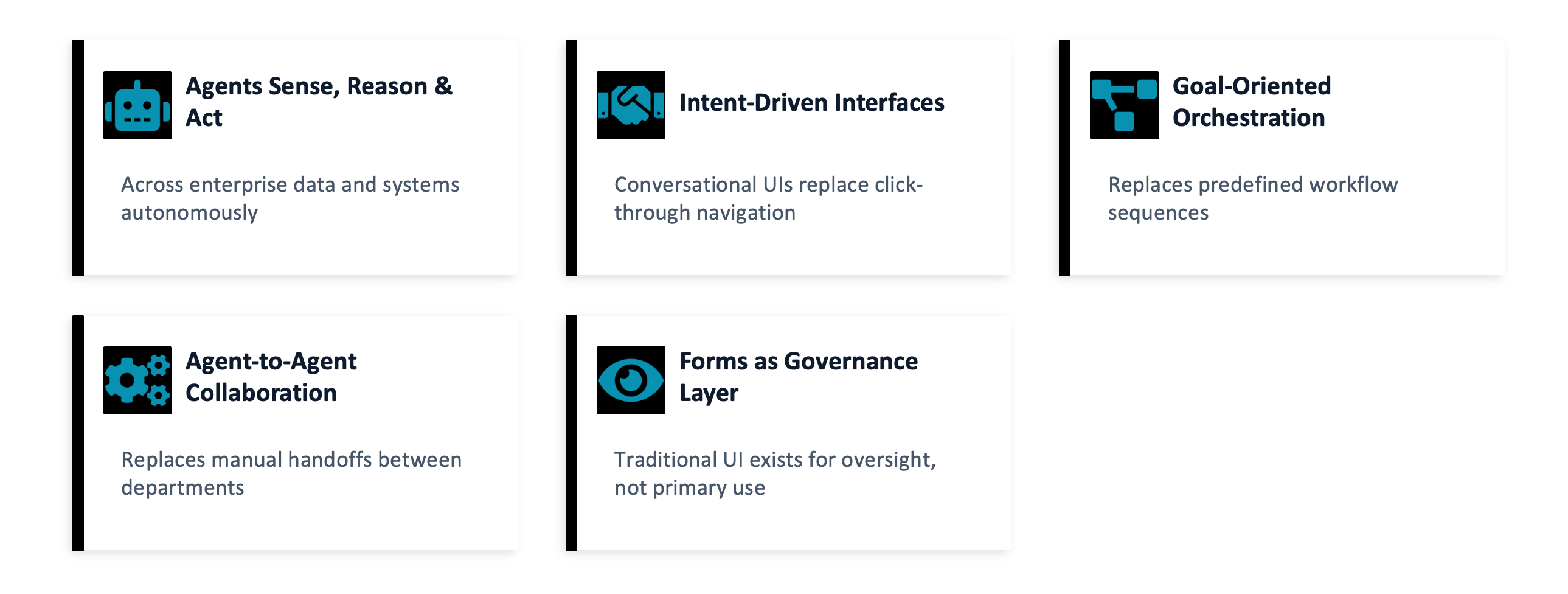
Agents sense, reason, and act across enterprise data and systems autonomously
Conversational and intent-driven interfaces replace click-through navigation
Goal-oriented orchestration replaces predefined workflow sequences
Agent-to-agent collaboration replaces manual handoffs between departments
Traditional UI, forms, and dashboards still exist — but as oversight and governance layers, not the primary mode of interaction
Think of it this way: in a traditional CRM, a sales rep logs in, navigates to a lead record, reviews the data, decides to follow up, drafts an email, logs the activity, and updates the pipeline stage. In an Agentic-First CRM, an agent continuously monitors signals, prioritizes leads based on real-time context, drafts personalized outreach, executes the follow-up, and updates the pipeline — all autonomously, with the sales rep stepping in only for strategic decisions and relationship-building.
The shift is from systems of record to systems of action.
Why This Matters Now
Three converging forces make Agentic-First architecture not just viable but necessary in 2026:
AI Model Capabilities Have Crossed the Enterprise Threshold. Large language models can now reason across multi-step problems, decompose complex tasks, maintain context over extended interactions, and invoke tools through structured protocols. This is fundamentally different from the rule-based automation or simple chatbot capabilities of even two years ago. Agents can now handle the ambiguity, exceptions, and contextual reasoning that previously required human judgment.
Interoperability Standards Are Maturing. Two critical open protocols have emerged that make agentic ecosystems practical. Anthropic’s Model Context Protocol (MCP), introduced in 2024, standardizes how agents connect to tools, data sources, and services. Google’s Agent-to-Agent (A2A) protocol, launched in April 2025 with over 50 technology partners, provides the communication framework for agents to collaborate across vendors and platforms. Together, MCP handles the “how agents interact with the world” layer, while A2A handles the “how agents work together” layer. AWS has joined the MCP steering committee. The Linux Foundation now houses A2A as an open-source project. Every major CRM, ERP, and ITSM platform vendor now supports one or both of these protocols. This is the equivalent of REST and GraphQL emerging for the API economy — the standardization that unlocks an ecosystem.
Every Major Platform Vendor Is Moving This Direction. Major CRM vendors are renaming entire product portfolios around agentic capabilities. Leading ERP platforms are positioning themselves as the “operational engine of AI-first organizations,” reframing the narrative from systems of record to systems of action. ITSM and workflow platforms have embedded agent orchestration directly into their architectures. Enterprise HCM and finance platforms are deploying agents across procurement, supply chain, and HR. Forrester’s Q4 2025 DXP Wave declared that “agents are now the center of the DXP — not a feature, not an add-on, the center.”
The Architecture Evolution: A Framework
To put Agentic-First in context, here’s how I see the full evolutionary arc of enterprise platform architecture:
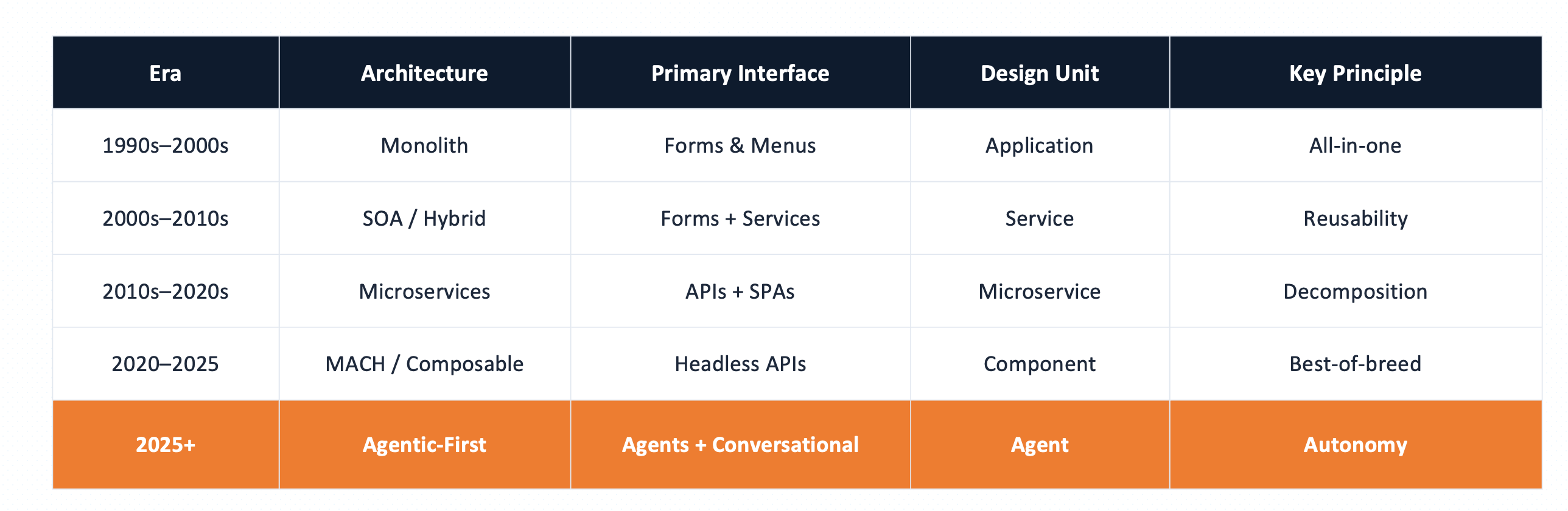
Each transition didn’t eliminate what came before — it subordinated it. APIs didn’t eliminate UIs; they made UIs one of many consumers. Agentic-First doesn’t eliminate forms and workflows; it makes them governance and override mechanisms rather than the primary interaction model.
Advantages of Agentic-First Systems
Elimination of Latency Between Insight and Action. Traditional systems surface data for humans to interpret and act on. Agentic systems collapse that gap. When an ERP agent detects a shipping delay, it doesn’t generate a report and wait for someone to read it — it reroutes deliveries, notifies customers, and updates inventory. The cycle time from signal to response drops from days or hours to seconds.
Continuous Process Optimization. Agents don’t just execute processes — they learn from outcomes, identify patterns, and adapt. Unlike static workflows that require manual redesign, agentic systems evolve their behavior based on feedback loops. This is the difference between automation (doing the same thing faster) and autonomy (doing the right thing adaptively).
Scalability Without Proportional Headcount. Organizations can scale operations without linearly increasing staff. Human effort shifts from coordination and execution to oversight, governance, and strategy. Bain’s 2025 Technology Report estimates 5–10% of technology spending could initially be directed toward foundational agentic capabilities, with up to half of technology spending eventually flowing to agents running across the enterprise.
Cross-System Intelligence. Agents operating across CRM, ERP, and DXP boundaries can make decisions that no single-system workflow could. A customer service agent that has context from sales history, billing status, product usage telemetry, and support case history can resolve issues that previously required escalation across three departments.
24/7 Operational Capacity. Unlike form-filling humans, agents operate continuously. A procurement agent can monitor supplier pricing, evaluate contract terms, and initiate reorder processes at 2 AM — making decisions that are consistent with organizational policies regardless of timezone or staffing levels.
The Honest Disadvantages
No architectural paradigm is without trade-offs, and intellectual honesty demands we address them:
Governance Complexity Increases Dramatically. When agents make autonomous decisions, the blast radius of errors expands. You need robust frameworks for identity, consent, fine-grained access control, and audit trails.
Observability Is Harder. Traditional systems have predictable execution paths. Agentic systems are stochastic — given the same input, they may take different actions. You need new monitoring paradigms: tracing agent reasoning chains, tracking tool invocations, measuring decision quality, not just system uptime.
Data Quality Becomes Mission-Critical in New Ways. Bad data in a traditional system causes inefficiency. Bad data in an agentic system causes autonomous bad decisions at scale. Data normalization, governance, and reconciliation become non-negotiable prerequisites.
Cultural Resistance Is Real. Employees may resist working alongside autonomous systems, especially if organizations fail to communicate clearly about accountability and career impact. This is a change management challenge, not a technology problem.
The Trust Gap. Most CISOs express deep concern about AI agent risks, yet few have implemented mature safeguards. Organizations are deploying agents faster than they can secure them. Building trust requires deliberate progression through maturity tiers.
The Honest Reality: Bolt-On Agentic vs. Born Agentic
Now, here’s where I need to challenge the prevailing narrative — including the marketing coming from every major vendor.
Every leading CRM, ERP, ITSM, and HCM platform is now describing itself as “agentic” — some even claim to be “agentic from the ground up.” And the capabilities they’ve built are genuinely impressive. But let’s apply a simple architecture test: if you removed the agent layer from any of these platforms, would the system still function as designed?
For every one of them, the answer is yes. And that tells you everything you need to know about the architectural reality.
When you log into any major enterprise platform today, you land on a dashboard with tabs, records, list views, and navigation menus. The agent or copilot experience is a feature you configure and deploy — it’s not the primary interface. The user’s journey still starts and ends with forms, workflows, and click-through navigation. Agents are supplementary, not foundational.
This is architecturally analogous to what happened with “mobile-first” in the early 2010s. Every enterprise vendor claimed to be mobile-first, but most platforms were desktop applications with responsive wrappers. The core data models, navigation paradigms, and interaction patterns remained desktop-native. We’re seeing the same pattern now.
The API layer tells the real story. Many of these platforms still have APIs designed for human-driven integrations — paginated REST endpoints, form-submission patterns, session-based authentication models. A truly Agentic-First API layer would be designed for agent consumption: semantic discovery via MCP, intent-based routing, streaming event architectures, and machine-readable capability descriptions. Most enterprise platform APIs today are “human-integration APIs with agent wrappers.”
And let’s be direct about something many architects already know: many of these “modernized” platforms were once monoliths that have evolved, but many have not been fully modernized. The core of many is still not fully headless. Many components are not API-first. Adding an agent layer on top of an architecture that wasn’t designed for agents doesn’t make it Agentic-First any more than adding a REST API to a monolith made it API-first.
I’d frame the current landscape in two categories:
Bolt-On Agentic — platforms that were architected and built for human users, now adding agent capabilities as a new layer. This describes virtually every major enterprise platform on the market today. Their agent capabilities are real and valuable, but the core architecture, data models, and primary interaction patterns remain human-centric. The forms and workflows remain first-class; agents remain second-class.
Born Agentic — platforms designed from inception with agents as the primary actors, where the user’s default experience is goal-driven and conversational, APIs are designed for agent consumption, and traditional forms exist only as governance overrides. This category is largely empty at enterprise scale today — which represents both the honest assessment and the enormous opportunity ahead.
The market data is compelling regardless. Gartner predicts 40% of enterprise applications will include task-specific AI agents by end of 2026, up from less than 5% in 2025. By 2028, a third of user experiences will shift from native applications to agentic front ends. The direction is clear — but the truly “born agentic” platforms that will define the next era are still being built.
The Team Model That Will Accelerate This: RDEs, FDEs, and Deep SMEs
Building Agentic-First platforms isn’t a technology-only challenge. It requires a fundamentally different team composition — one that combines deep engineering, deep industry knowledge, and deep process expertise working together in an embedded, co-creative model.
I believe the accelerant for building these next-generation platforms is a team model that brings together four critical roles:
Reinvention Deployed Engineers (RDEs) are the model Accenture has pioneered — engineers embedded directly with clients to reimagine and rebuild processes with AI at the center. Unlike traditional consultants who advise, or traditional engineers who build to spec, RDEs operate at the intersection: they understand the client’s operational reality intimately while possessing the technical depth to architect and build agentic solutions in real time. Accenture has trained 30,000 consultants in partnership with Anthropic specifically for this model. The key distinction is in the name itself — “reinvention,” not “implementation.” RDEs don’t bolt agents onto existing processes. They reimagine the process with agents as the primary actors.
Forward Deployed Engineers (FDEs) — the model pioneered by Palantir and now adopted by major CRM, ITSM, and IT services companies — bring a complementary capability. FDEs embed within the customer’s environment to solve the hardest technical integration challenges: connecting to legacy systems, navigating fragmented data architectures, building the bridges between what the agentic platform needs and what the enterprise environment actually looks like. The magic of FDEs is their focus on “many capabilities for a single customer” rather than “one capability for many customers.” In an Agentic-First world, FDEs are the ones who ensure agents can actually access, reason over, and act on the enterprise’s real data — not sanitized demo data.
Deep Industry Subject Matter Advisors bring the domain expertise that no engineer can substitute. An agentic supply chain system for pharmaceutical manufacturing has fundamentally different regulatory, compliance, and operational constraints than one for consumer goods retail. These advisors ensure that agent behaviors, guardrails, escalation paths, and decision boundaries reflect the actual industry reality — not generic best practices. Without them, you build technically elegant agents that make operationally dangerous decisions.
Deep Process Subject Matter Advisors understand how work actually gets done — not how org charts say it should get done. They know where the tribal knowledge lives, which handoffs create bottlenecks, which exceptions account for 80% of the complexity, and which workarounds have become load-bearing pillars of the operation. When you’re redesigning processes with agents as first-class citizens, these advisors ensure you’re reimagining the right processes in the right order, and that agent-driven orchestration accounts for the edge cases that break naive automation.
The power is in the combination. RDEs and FDEs working alongside deep industry and deep process SMEs create a team that can simultaneously reimagine processes (RDEs), solve the hardest technical integration challenges (FDEs), ensure industry-specific compliance and operational viability (industry SMEs), and ground the entire design in how work actually happens (process SMEs).
This isn’t a theoretical model. Major CRM, ITSM, and supply chain platform vendors are already using FDEs to accelerate agentic deployments and co-innovate with customers. Some are running 90-day proof-of-concept engagements with forward-deployed engineers who build custom agents alongside the customer. The companies moving fastest on agentic transformation are the ones deploying embedded, cross-functional teams — not throwing technology over the wall.
The Bottom Line for Technology Leaders
If you are a CIO, CTO, or enterprise architect, the strategic question isn’t “should we add AI to our platforms?” — it’s “are we designing our next-generation systems with agents as first-class citizens?”
Here’s my recommendation:
1. Start with agent-readiness, not agent deployment. Invest in data quality, semantic layers, API maturity, and governance frameworks. These are prerequisites, not afterthoughts.
2. Adopt MCP and A2A now. Ask your vendors about their protocol support. Thirty percent of enterprise app vendors will launch MCP servers in 2026, according to Forrester. If your vendor isn’t planning for interoperability, that’s a red flag.
3. Think in tiers. Progress deliberately from foundation (tool orchestration, governance) to workflow automation to constrained autonomy. Organizations that rush to full autonomy without governance foundations will face increasing regulatory scrutiny and operational risk.
4. Redesign processes, not just technology. The competitive advantage doesn’t come from deploying agents — it comes from reimagining how work gets done, outcome by outcome, seam by seam.
5. Treat agents as workforce members. They need identity management, access controls, performance monitoring, and accountability frameworks — just like human employees.
6. Build the right team, not just the right technology. Deploy cross-functional teams of RDEs, FDEs, industry SMEs, and process SMEs working together in an embedded model. Technology alone won’t get you to Agentic-First.
We are witnessing the early innings of the most significant shift in enterprise architecture since the move to cloud. The organizations that recognize Agentic-First as an architectural paradigm — not just an AI feature — will define the next decade of enterprise technology leadership.
The question isn’t whether this shift is coming. It’s whether you’ll architect for it, or retrofit around it.
#AgenticAI #EnterpriseArchitecture #MACH #DigitalTransformation #AI #FutureOfWork #AgentFirstArchitecture
Spot on with the 'Born Agentic' vs. 'Bolt-On' distinction. It’s the perfect litmus test for what’s actually happening in the industry right now. If you can ' unplug ' the AI and the system still runs like normal, it’s not a transformation, it’s just a feature. Thanks for calling out the difference so clearly. This is the level of architectural honesty we need to see from vendors right now.