

I said this in Article 1 of this series, and six articles later, it’s time to go deep on what it means architecturally.
In the previous articles, I established the paradigm (Article 1), defined the protocol stack (MCP and A2A, Articles 2-3), published the reference architecture (Article 4), defined the governance hierarchy (Article 5), and provided the LLM selection framework (Article 6). Every one of those articles pointed back to the same foundational layer: data. The orchestration layer can’t route agents without context. The agent layer can’t reason without knowledge. The protocol layer can’t connect agents to data without the data being accessible, structured, and meaningful. The governance layer can’t enforce policies without knowing what data agents are accessing and what decisions they’re making.
Data is not a supporting layer in Agentic-First architecture. It is the architecture. Everything else is machinery built on top of what your agents know, how they access it, and how reliably they can reason over it.
This article provides the data architecture framework for Agentic-First systems.
The Fundamental Shift: Your Data Consumers Are Now Agents
Traditional data architecture assumed a human at the end of the pipeline. A human writes a SQL query. A human reads a dashboard. A human interprets a report and applies judgment, institutional knowledge, and common sense to compensate for data gaps, inconsistencies, and ambiguities.
Agentic systems remove that human compensator from the fast path. An agent receives data and acts on it autonomously, at speed and at scale. If the data says a customer’s lifetime value is $50,000 when it’s actually $5,000 (a decimal place error in a legacy migration), the agent treats that customer as a top-tier account and allocates premium resources. If the data shows a supplier’s risk score as “low” because the risk assessment hasn’t been updated in six months, the procurement agent continues placing orders with a supplier that’s on the verge of insolvency.
This isn’t a theoretical risk. It’s the operational reality of every enterprise that deploys agents against production data without rethinking its data architecture.
The shift requires three fundamental changes in how enterprises think about data:
Data must be machine-interpretable, not just machine-readable. Traditional systems store data that humans can read and interpret. Agentic systems need data that agents can understand - with semantic context, relationship information, and domain knowledge embedded in the data layer itself. An agent needs to know that “customer” in the CRM and “client” in the billing system refer to the same entity. The “revenue” in the US subsidiary is in USD, and the “revenue” in the European subsidiary is in EUR. That “active” in one system means “has logged in within 30 days” and “active” in another means “has a current contract.”
Data must be current, not stale. Traditional analytics can work with yesterday’s batch export. Agents making operational decisions need current data. A customer support agent resolving a billing dispute needs the customer’s current balance, not the balance as of last night’s ETL run. A supply chain agent rerouting shipments needs current inventory positions, not yesterday’s warehouse count.
Data quality is no longer a reporting problem; it’s a decision-making problem. In a dashboard, bad data causes a wrong number on a chart. In an agentic system, bad data causes a wrong decision that triggers downstream actions, affects customers, commits resources, and creates liability, all before any human sees what happened.
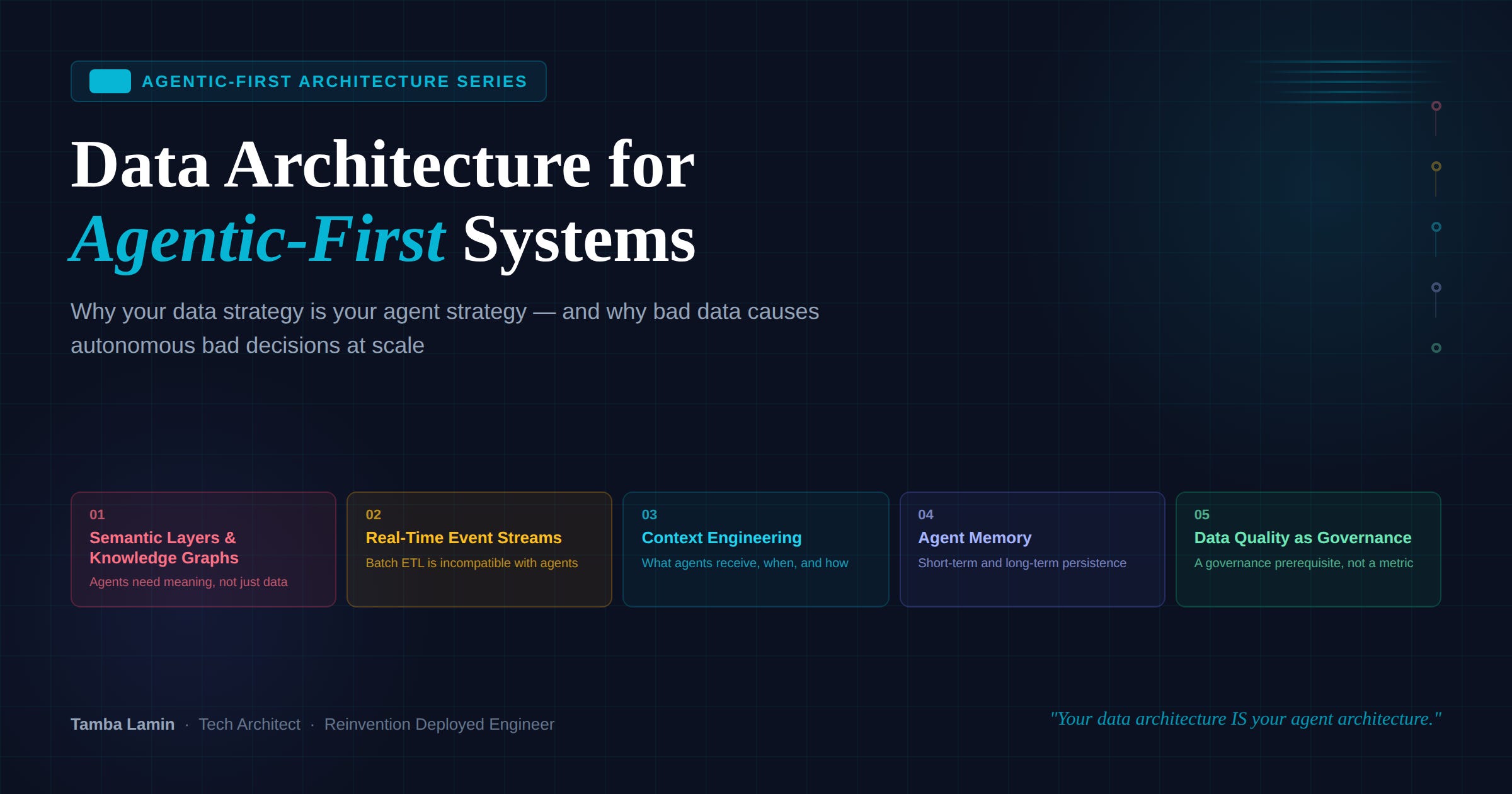
The Five Pillars of Agentic Data Architecture
Pillar 1: Semantic Layers and Knowledge Graphs
Agents don’t reason over tables and columns. They reason over concepts, relationships, and meaning. The semantic layer is what translates raw enterprise data into knowledge that agents can use.
A semantic layer provides a unified business vocabulary that resolves the “same thing, different name” problem across enterprise systems. It maps “customer” in CRM to “account” in billing to “buyer” in procurement, creating a single concept that agents can reference regardless of which underlying system holds the data. It defines relationships between concepts: a customer has orders, orders have line items, line items reference products, products belong to categories, categories have margin targets. An agent reasoning about “which customers should we prioritize for the Q4 campaign” needs all of these relationships to produce a useful answer.
Knowledge graphs take this further by representing the full web of enterprise knowledge as a navigable structure. Unlike relational databases that answer “what data do we have about X?”, knowledge graphs answer “what do we know about X and everything related to X?”, the kind of contextual, associative reasoning that agents need for complex decisions.
The emergence of GraphRAG, retrieval-augmented generation powered by knowledge graph backbones, represents the convergence of these patterns. Traditional RAG retrieves chunks of text based on vector similarity. GraphRAG retrieves structured knowledge based on semantic relationships, enabling agents to answer questions that require connecting information across domains, departments, and systems. For enterprise-agentic deployments, GraphRAG is not an enhancement; it’s becoming the standard retrieval pattern for any agent that needs to reason across organizational knowledge.
The architectural implication: invest in building your enterprise knowledge graph before you build your agents. The knowledge graph is the agent’s map of the world. Without it, agents are navigating in the dark, making decisions based on fragments of text rather than structured, validated, relationship-rich knowledge.
Pillar 2: Real-Time Data Pipelines and Event Streams
Agents that make operational decisions need operational-speed data. The batch ETL paradigm, extract data overnight, transform it, load it into a warehouse, report on it tomorrow, is architecturally incompatible with agents that need to act now.
In an Agentic-First system, data flows through event streams in real time. When a customer places an order, an event is published. When inventory drops below a threshold, an event is published. When a supplier’s risk score changes, an event is published. Agents subscribe to the events that matter for their domain and act on them immediately.
This requires a shift from request-response data access to event-driven data access. In the reference architecture (Article 4), the event infrastructure sits in the Infrastructure Layer but connects upward through every layer. MCP servers can publish events when data changes. A2A agents can subscribe to events from other agents. The orchestration layer can trigger multi-agent workflows based on event patterns.
The practical architecture combines two patterns: event streams for real-time operational data (customer actions, transactions, inventory changes, system alerts) and semantic queries for analytical and historical context (customer lifetime value, historical purchasing patterns, trend analysis). Agents need both the real-time signal that something is happening now and the historical context to interpret its meaning.
For most enterprises, the critical investment is the event streaming infrastructure. If your architecture is primarily request-response today, systems that respond to queries rather than publishing changes, this is one of the highest-leverage preparations for agentic deployment. Message brokers and event streaming platforms (vendor-agnostic, any mature event bus will work) create the real-time data fabric that agents depend on.
Pillar 3: Context Engineering
Context engineering is the emerging discipline that may matter more for agentic success than any other data architecture investment. It is the systematic design of what information agents receive, when they receive it, and in what format, optimized for the LLM’s context window constraints and the agent’s decision-making needs.
In a traditional application, the developer hardcodes which database queries to run and which API calls to make. The data access pattern is deterministic and static. In an agentic system, the agent determines what information it needs based on the task, but the architecture controls what information is available and how it’s presented.
Context engineering addresses several critical challenges:
What to include. An agent processing a customer complaint doesn’t need the customer’s entire transaction history; it needs the relevant transactions, the customer’s sentiment trend, the applicable policies, and the resolution precedents. Including everything overloads the context window. Including too few leaves leaves the agent without the information needed for a good decision.
What to exclude. PII that the agent doesn’t need for its task should never enter its context window. This is both a security requirement (aligned with the Security & Identity cross-cutting layer from Article 4) and a cost optimization (fewer tokens = lower cost). Context engineering implements data minimization as an architectural pattern, not just a compliance checkbox.
How to format. The same information, formatted differently, produces different-quality reasoning from the LLM. Structured data (JSON, tables) produces more reliable tool-calling behavior than unstructured prose. Explicit relationship information (“Customer X has 3 open orders, totaling $45,000, with the oldest 15 days overdue”) produces better reasoning than implicit information that requires the model to infer relationships.
When to refresh. Static context loaded at the start of an agent session becomes stale over long-running workflows. Context engineering includes patterns for refreshing critical context at decision points, re-fetching current inventory before a reorder decision, re-checking customer status before sending a communication, and re-validating policy compliance before approving an action.
In the reference architecture, context engineering sits in the Data & Context Layer and interfaces with the Agent Layer above and the Protocol Layer (MCP) below. MCP servers are the delivery mechanism; they provide the tools and resources that agents use to access data. Context engineering is the intelligence that determines which MCP servers to call, what to request, and how to present the results to the agent.
Pillar 4: Agent Memory - Short-Term and Long-Term
Agents need memory. Not just the LLM’s context window (which is ephemeral and resets between sessions), but persistent memory that enables agents to learn, maintain continuity, and build institutional knowledge over time.
Short-term memory is the context maintained within a single task or workflow. When a procurement agent is processing a purchase request, it needs to remember the steps already completed, the decisions already made, and the information already gathered, even as the workflow spans multiple model calls and tool invocations. Short-term memory is typically implemented through conversation history management and state tracking within the orchestration layer.
Long-term memory is the knowledge that persists across tasks, across sessions, and across time. An agent who resolved a similar customer complaint last month should be able to recall that resolution. An agent that learned that a particular supplier frequently ships late should factor that into future procurement decisions. Long-term memory is emerging as a critical differentiator between agents that repeat the same mistakes and agents that genuinely improve over time.
The architectural options for agent memory are evolving rapidly. Vector databases provide semantic retrieval over past interactions. Key-value stores provide fast access to structured state. Knowledge graphs provide relationship-aware memory that connects past decisions to their contexts and outcomes. Contextual memory systems, which emerged as production-ready in 2025, enable agents to store and access pertinent information over extended periods, maintain state, and adapt based on feedback.
The design decision is not whether to implement agent memory, but how much and what kind. For Tier 1 (Foundation) deployments, short-term memory within individual workflows is sufficient. For Tier 2 (Workflow Automation), cross-workflow memory that enables agents to learn from patterns is valuable. For Tier 3 (Constrained Autonomy), comprehensive long-term memory that represents institutional knowledge becomes essential, and its quality becomes a governance concern, because agents making autonomous decisions based on their accumulated memory are only as good as that memory’s accuracy and relevance.
Pillar 5: Data Quality as a Governance Prerequisite
In an Agentic-First system, data quality is not a data team problem. It is a governance problem. If you wouldn’t let an employee make autonomous decisions based on unverified, inconsistent, outdated information, you shouldn’t let an agent do it either.
Data quality for agentic systems requires a higher standard than data quality for reporting. Reports are consumed by humans who can exercise judgment about the data’s reliability. Agents consume data as if it’s ground truth and act accordingly. This means:
Accuracy must be continuously measured and monitored. Not in quarterly data quality audits, but in real-time monitoring that catches data issues before agents act on them. The Governance & Observability cross-cutting layer from Article 4 should include data quality metrics alongside agent performance metrics.
Completeness must be assured for critical decision fields. An agent making a credit decision needs to know that the customer’s credit score is current and complete, not that it was populated six months ago and never refreshed. Missing data is worse than wrong data in some contexts, because the agent may not recognize it as missing.
Timeliness must match the agent’s decision cadence. Data that’s refreshed daily is adequate for agents making daily planning decisions. It’s dangerously stale for agents making real-time operational decisions. The required freshness is determined by the agent’s use case, and should be defined as part of the agent’s governance specification.
Lineage must be traceable. When an agent makes a decision, you must be able to trace the data that informed that decision. This is both a regulatory requirement (the EU AI Act demands explainability for high-risk AI decisions) and an operational requirement (when something goes wrong, you need to understand whether the error was in the agent’s reasoning or in the data it reasoned over).
MCP as the Data Bridge
In the reference architecture, MCP (Model Context Protocol) is the mechanism through which agents access data. MCP servers expose enterprise data as Resources that agents can read, Tools that agents can invoke, and Prompts that encode best practices for using the data.
This architectural pattern, data exposed through MCP rather than through direct database connections, provides several critical advantages for agentic data architecture:
Abstraction. Agents don’t need to know whether customer data lives in a CRM database, a data warehouse, or a knowledge graph. The MCP server abstracts the underlying storage and presents a unified interface. This means you can migrate databases, consolidate systems, and restructure data without rewriting agents.
Access control. MCP servers enforce who can access what data; the Security & Identity cross-cutting layer applies at the MCP boundary. An agent’s MCP connection defines its data permissions, just as an employee’s system access defines theirs.
Context engineering enforcement. MCP servers control what data agents receive and in what format. They implement the context engineering patterns described above, filtering, formatting, and optimizing data presentation for the agent’s specific needs and the LLM’s context window constraints.
Audit surface. Every data access through MCP is loggable and traceable. The Governance & Observability cross-cutting layer can monitor every data request, every tool invocation, and every resource access, creating the complete audit trail that regulators require.
Your data catalog becomes your agent’s map of the world. Every entry in the catalog that has an MCP server becomes a data source your agents can access. Entries without MCP servers are invisible to agents, which means that, in practice, prioritizing MCP server development is prioritizing which data your agents can use.
The Honest Gaps
Most enterprises are not data-ready for agents. Surveys consistently show that fewer than a quarter of organizations rate their data as “very ready” for AI. Data silos, inconsistent semantics, stale pipelines, and missing governance frameworks are the norm, not the exception. The gap between where most enterprises are and where they need to be for production agentic systems is measured in years of investment, not months.
Knowledge graph construction is expensive and time-consuming. Building a comprehensive enterprise knowledge graph requires ontology design, entity extraction, relationship mapping, and continuous maintenance. The payoff is substantial, but the upfront investment is significant, and most enterprises don’t have the skills in-house.
Context engineering is still more art than science. There are no mature frameworks, tools, or best practices for systematically designing agent context. Most teams learn through trial and error, discovering which contexts produce good agent behavior through iterative testing. This is improving, but slowly.
Agent memory at enterprise scale is unsolved. Short-term memory within sessions is well-understood. Long-term memory that persists across sessions, maintains accuracy over time, ages gracefully, and doesn’t accumulate bias or outdated information is a research frontier, not a production capability for most organizations.
Data quality monitoring for agentic systems has no established playbook. Traditional data quality tools measure accuracy, completeness, and timeliness against static thresholds. Agentic data quality needs dynamic thresholds tied to agent decision criticality, real-time monitoring tied to agent action frequency, and feedback loops that connect data quality issues to agent decision quality.
What This Means for Your Data Strategy
If you take one thing from this article, start with your data, not your agents. Every Tier 1 (Foundation) deployment should begin with a data readiness assessment. Mapping the data sources your agents will need, evaluating their quality, freshness, and semantic consistency, and identifying the gaps that must be closed before agents can operate reliably.
Build your semantic layer before you build your agents. Invest in resolving the “same thing, different name” problem across your enterprise systems. Whether through a formal knowledge graph, a lighter semantic mapping layer, or a well-governed data catalog, your agents need a unified understanding of your business entities and their relationships.
Invest in event streaming infrastructure. If your data architecture is primarily batch, begin the transition to real-time event streams for the data domains where agents will operate. This is the highest-leverage infrastructure investment for agentic readiness.
Develop MCP servers for your critical data sources. Each MCP server you build extends your agents’ reach by one data source. Prioritize the data sources your first agent use cases need: CRM, ERP, ticketing, knowledge bases, and build outward from there.
Implement context engineering as a discipline, not an afterthought. Designate team members who own the design of what information agents receive. This is a new role: context engineers, who sit at the intersection of data engineering, agent design, and domain expertise. They will be among the most valuable people in your agentic organization.
Treat data quality as a first-class governance concern. In your governance framework (Article 5), data quality monitoring should sit alongside agent performance monitoring. When an agent makes a bad decision, the root cause analysis should always include: Was the data wrong?
Your data architecture is your agent architecture. The agents are only as intelligent as the data they reason over, only as current as the data they access, and only as trustworthy as the data quality you enforce. Everything else in the Agentic-First stack: the protocols, the models, the governance, amplifies what the data layer provides. Amplifying bad data is not a technology success. It’s an organizational risk.
This is the seventh article in my Agentic-First Architecture series. Article 1 introduced the paradigm. Articles 2 and 3 defined the protocol stack (MCP + A2A). Article 4 published the reference architecture. Article 5defined the Human Oversight Hierarchy. Article 6 addressed LLM selection. Article 8 will cover the infrastructure topology: cloud, on-premises, and edge, and why the agentic era is forcing a “great rebalancing” of where compute lives. All previous articles are available on my Substack.
I’d welcome feedback from data architects and platform engineers: how are you preparing your data infrastructure for agentic consumption? What data quality challenges are you encountering? Is context engineering emerging as a discipline in your organization?
#AgenticAI #DataArchitecture #EnterpriseArchitecture #KnowledgeGraphs #ContextEngineering #AgentFirstArchitecture