

Most enterprises approach LLM selection like they approach ERP selection: evaluate the market leaders, run a proof of concept, pick one, and standardize. That approach made sense when the LLM’s primary user was a human interacting with a chatbot. It is architecturally wrong when the primary consumers are autonomous agents that reason, plan, select tools, coordinate with other agents, and make decisions at enterprise scale.
In an Agentic-First system, the LLM isn’t the product; it’s a component. Different agents have different computational profiles. A compliance reasoning agent needs deep multi-step logic and high accuracy on nuanced regulatory interpretation. A data classification agent needs speed, low latency, and cost efficiency across millions of invocations per day. A customer-facing support agent needs conversational quality, tool-calling reliability, and the ability to maintain context over extended interactions. A code generation agent needs high-fidelity structured output and the ability to sustain operations for hours without degrading.
No single model is optimal for all of these workloads. And treating LLM selection as a single-vendor decision, rather than an architectural decision about which models serve which agents for which tasks, is one of the most expensive mistakes an enterprise can make in the agentic era.
This article provides the framework for making that architectural decision correctly.
What Changes When Agents Are the Primary LLM Consumers
In a chatbot, the human is the quality filter. If the model produces a mediocre response, the human recognizes it and asks again. If the model hallucinates, the human notices. If the model’s structured output is slightly malformed, the human still interprets it.
In an agentic system, there is no human quality filter in the fast path. The agent receives the model’s output and acts on it - calling tools, making decisions, coordinating with other agents. If the model’s tool call is malformed, the agent fails. If the model hallucinates a data point, the agent makes a decision on false information. If the model’s reasoning is shallow, the agent’s plan is flawed, and downstream agents inherit that flawed plan.
This means the capabilities that matter for agentic use are fundamentally different from the capabilities that matter for chat:
Tool-calling reliability becomes the most critical capability. When an agent needs to invoke an MCP tool - querying a database, updating a CRM record, triggering a workflow - the model must produce precisely formatted function calls with correct parameters. A 95% tool-calling success rate that seems acceptable in a demo becomes catastrophic in a production system, making thousands of tool calls per hour: 50 failures per thousand calls, compounding across multi-step workflows.
Structured output fidelity determines whether agents can communicate. A2A protocol exchanges, MCP tool invocations, and orchestration instructions all require models to produce valid JSON, adhere to schemas, and maintain structural consistency across extended interactions. Models that drift from structured formats under load or after many turns break agent-to-agent communication.
Reasoning depth and planning determine whether agents can decompose complex goals into effective action sequences. The orchestration layer depends on the model’s ability to understand a goal, identify the required steps, anticipate dependencies, and produce a coherent plan, not just a plausible next token.
Context window and utilization affect how much state an agent can maintain. But raw context window size is misleading: research shows that models claiming million-token windows experience significant performance degradation well before that limit. What matters is effective context utilization, how accurately the model reasons over information at various positions within its context window.
Latency and throughput determine whether the system is responsive. An agent waiting 10 seconds for a model response in a multi-step workflow that involves 15 model calls creates a 2.5-minute human-perceptible delay. For real-time use cases like customer service or dynamic pricing, latency requirements may disqualify otherwise capable models.
Sustained operation reliability is a new dimension entirely. Unlike chatbots, which measure interactions in minutes, agentic workflows can run for hours. Models must maintain quality, coherence, and tool-calling accuracy across extended sessions without degradation, which the industry is beginning to call “endurance.”
The Model Landscape Through an Agentic Lens
The LLM landscape has consolidated around three tiers, each with distinct agentic strengths. The key insight for architects: you probably need models from at least two of these tiers, and possibly all three.
Frontier Models: The Reasoning Tier
These are the most capable models available - optimized for the hardest reasoning, planning, and multi-step tasks. They excel at complex orchestration decisions, nuanced compliance reasoning, sophisticated code generation, and tasks where accuracy is more important than speed.
In the current landscape, frontier models deliver the highest scores on agentic benchmarks like Terminal-Bench, SWE-bench Verified, and the GAIA general assistant benchmark. They’re the right choice for orchestrator agents (deciding which specialist agents to invoke and how), compliance and legal reasoning agents, complex financial analysis agents, and any agent where a wrong answer has high consequences.
The trade-off: frontier models are the most expensive per token, have the highest latency, and are overkill for routine tasks. Using a frontier model to classify support tickets or generate routine email responses is like using a Formula 1 engine to drive to the grocery store - technically capable, economically absurd.
Mid-Tier Models: The Workhorse Tier
These models balance capability and cost, delivering strong performance on standard agentic tasks at a fraction of the cost of frontier models. They handle tool calling reliably, produce consistent structured outputs, and maintain quality across extended interactions.
Mid-tier models are the right choice for the majority of production agent workloads: customer service agents, content generation agents, data extraction and transformation agents, and most routine business process agents. They typically run at one-third to one-fifth the cost of frontier models while delivering 85-90% of the capability for standard tasks.
The key evaluation criterion for mid-tier models in agentic use: sustained operation reliability. Some models in this tier can maintain consistent performance across sessions exceeding 30 hours, a critical capability for agents managing long-running workflows.
Open-Source and Specialized Models: The Efficiency Tier
Open-source and domain-fine-tuned models lie at the efficiency end of the spectrum. They offer the lowest cost per token (especially when self-hosted), full data sovereignty control, and the ability to fine-tune for specific domain tasks.
Recent advances have dramatically closed the capability gap. Leading open-source models now achieve 90%+ scores on tool-use benchmarks, making them viable for production agentic workloads where the task is well-defined and the domain is bounded. They’re the right choice for high-volume, low-complexity agent tasks (classification, routing, extraction), on-premises deployments where data cannot leave the network, and domain-specific agents where fine-tuning on proprietary data creates a capability advantage that general models can’t match.
The trade-off: open-source models require infrastructure expertise to deploy and maintain, have less consistent tool-calling behavior at the edges, and may lack the reasoning depth for complex orchestration tasks.
Reasoning Models vs. Non-Reasoning Models: The Architectural Fork
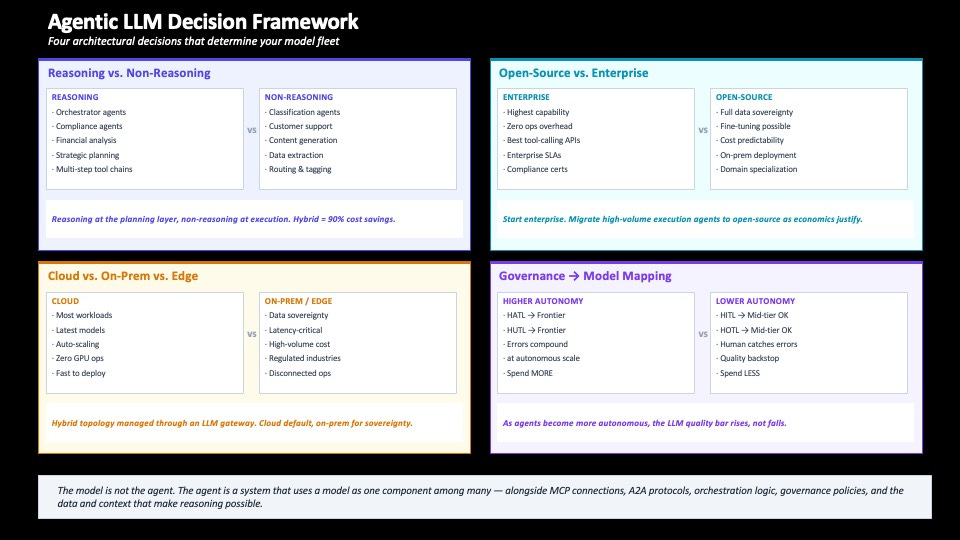
The most consequential model architecture decision in the agentic era isn’t which vendor, it’s whether your agent needs a reasoning model or a non-reasoning model. This distinction, which barely existed two years ago, now represents a fundamental fork in how models process information, and getting it wrong for your agent workload either burns money or produces inadequate results.
Non-reasoning models (sometimes called “standard” or “instruct” models) generate responses through a single forward pass, token by token, without explicit internal deliberation. They’re fast, have predictable latency, and are cost-efficient. For agentic use, they excel at tasks with clear patterns: tool calling from well-defined schemas, data extraction from structured documents, classification and routing, content generation from templates, and real-time conversational interactions where speed matters more than depth.
Reasoning models (sometimes called “thinking” or “chain-of-thought” models) perform explicit multi-step deliberation before producing their final output. They decompose problems, consider alternatives, verify their own logic, and produce more reliable conclusions on complex tasks. The trade-off is significant: reasoning models consume substantially more tokens (the “thinking” process generates internal tokens that count toward cost), have higher and less predictable latency (you can’t predict how long the model will “think”), and cost 3-10x more per completion than equivalent non-reasoning models.
For agentic systems, the implications are architectural:
Use reasoning models for agents that plan, decide, and judge. The orchestrator agent that decomposes “close this quarter’s at-risk deals” into a sequence of specialist agent tasks needs to reason about dependencies, priorities, and constraints. A compliance agent evaluating whether a procurement decision violates regulatory thresholds needs to consider multiple rules, exceptions, and precedents. A financial analysis agent determining whether market conditions warrant a hedging strategy needs genuine multi-step logic. These agents make decisions that cascade - a shallow answer at the top propagates shallow execution everywhere downstream.
Use non-reasoning models for agents that execute, classify, and communicate. The data classification agent processing thousands of documents per hour doesn’t need to deliberate; it needs to pattern-match quickly and accurately. The customer support agent handling routine inquiries needs fast, natural responses with reliable tool calling, not extended contemplation. The content formatting agent preparing CMS entries from approved drafts needs speed and structural consistency, not deep reasoning.
The hybrid pattern is emerging as the standard. Mature agentic systems use reasoning models at the orchestration and decision layers, and non-reasoning models at the execution and interaction layers. This mirrors the Plan-and-Execute pattern: a reasoning model creates the plan (slowly, carefully, expensively), and non-reasoning models execute the steps (quickly, efficiently, cheaply). The orchestration layer in the reference architecture (Article 4) is where this routing decision is made, and it’s one of the highest-leverage architectural decisions in the entire system.
One critical nuance: some model providers now offer controllable reasoning depth, allowing you to dial the “thinking effort” up or down per request. This is architecturally significant because it means a single model can serve as both a reasoning and non-reasoning model depending on the task, reducing the operational complexity of maintaining separate model deployments. When evaluating fleet models, assess whether they offer this flexibility.
Open-Source Models vs. Enterprise Models: The Control-Capability Spectrum
The open-source vs. enterprise model decision is not about quality; it’s about the trade-off between control and convenience, between ownership and operational overhead. Both categories now produce models that are viable for production agentic workloads. The question is: which trade-offs can your organization accept?
Enterprise models (cloud-hosted, API-accessed, vendor-managed) offer the highest capability ceiling, the lowest operational overhead, and the fastest path to production. You call an API, you get a response. The vendor handles infrastructure, scaling, model updates, and availability. For most enterprise-agentic deployments, this is the starting point, and for many, it’s the permanent state.
The advantages for agentic use are substantial: enterprise models typically lead in tool-calling reliability (their APIs are optimized for function calling), have the most mature structured output support (JSON mode, schema enforcement), offer the longest effective context windows, and provide enterprise-grade SLAs, security certifications (SOC 2, HIPAA, FedRAMP), and compliance documentation.
The risks are equally real: vendor lock-in (your agents become dependent on one provider’s API format and capabilities), data exposure (every prompt and response transits through the vendor’s infrastructure), pricing vulnerability (the vendor controls the economics and can change pricing at any time), and availability dependence (a provider outage takes down every agent that depends on it).
Open-source models (self-hosted or hosted through open infrastructure) offer full data sovereignty, deployment flexibility, cost predictability, and the ability to fine-tune for domain-specific agentic tasks. You own the model weights. You control where inference runs. Your data never leaves your network.
The agentic capability gap has narrowed dramatically. Leading open-source models now achieve 90%+ on tool-use benchmarks and deliver competitive performance on reasoning tasks. For well-defined, domain-bounded agentic workloads, the classification agents, extraction agents, and routing agents that constitute the majority of agent invocations in a production system, open-source models can be not just adequate but superior, because fine-tuning on your specific tool schemas, your data formats, and your domain vocabulary can produce tool-calling reliability that exceeds general-purpose enterprise models on your specific tasks.
The trade-offs are operational: you need GPU infrastructure (cloud or on-premises), ML engineering expertise for deployment and optimization, a model serving stack (quantization, batching, caching), monitoring and alerting for model performance, and a process for evaluating and adopting new model versions. For organizations without existing ML infrastructure, these operational costs can exceed the API costs of enterprise models.
The practical recommendation for most enterprises: Start with enterprise models for all agents. As you identify high-volume, well-defined agent workloads where cost is a concern or data sovereignty is required, evaluate open-source alternatives for those agents. The model fleet pattern supports this naturally; your orchestrator and complex reasoning agents stay on enterprise models, while your high-volume execution agents migrate to self-hosted open-source as the workload and economics justify.
Don’t choose ideology over architecture. The right answer for most enterprises is both enterprise models, where capability and convenience matter most, and open-source models, where cost, sovereignty, and specialization matter most.
The Token Economics of Agentic Systems
Token economics in agentic systems are fundamentally different from chatbot economics, and most enterprises underestimate the cost differential by an order of magnitude. Understanding this is not optional; it’s the difference between a sustainable agentic deployment and one that gets shut down at the first quarterly budget review.
Why agentic systems consume more tokens than chatbots. A chatbot interaction typically consists of a single exchange: a user prompt and a model response. An agentic workflow is a cascade of model calls. A single “resolve this customer’s billing dispute” intent might involve: the orchestrator agent reasoning about the plan (1 call), the CRM agent retrieving customer data via MCP tool calls (2-3 calls), the billing agent analyzing the dispute (1-2 calls), the resolution agent drafting a response (1 call), the compliance agent reviewing the draft (1 call), and the orchestrator confirming the plan is complete (1 call). That’s 7-9 model calls for a single user intent. Multiply by the system prompt overhead (tool definitions, context, instructions) repeated on every call, and a single agent action can consume 50,000-100,000 tokens.
At enterprise scale, with thousands of agent actions per day, the token economics become the dominant cost driver. This is why cost per agent action, not cost per token, matters.
The cost levers architects can control:
Model tiering is the most powerful lever. Using a frontier model at $15 per million output tokens for a classification task that a mid-tier model handles at $3 per million is a 5x cost penalty for no capability benefit. The model fleet pattern exists precisely to optimize this, match model cost to task complexity.
Prompt caching is the second most powerful lever, and the most underutilized. Agent system prompts, which typically contain tool definitions, behavioral instructions, and context, are sent identically on every invocation. Cloud providers now offer discounts of 50-90% on cached input tokens. For agentic systems with a system prompt of 2,000-5,000 tokens and user-specific content of 500-1,000 tokens, caching can reduce input costs by 60-80%.
Structured output enforcement reduces retry costs. Models that support native JSON mode or schema-constrained output produce valid, structured responses on the first attempt, eliminating the retry loops that quietly double- or triple-tokenize.
Context window management prevents over-stuffing. Agents that receive more context than they need consume more input tokens than necessary. Context engineering - deliberately designing what information each agent receives is both a quality improvement and a cost optimization.
Reasoning depth control, when available, lets you dial the thinking effort per request. A routine tool call doesn’t need extended reasoning; a complex planning decision does. Controlling this per-request rather than per-model can reduce reasoning token consumption by 40-60% across a fleet.
A realistic cost model for enterprise agentic systems: An organization running 10,000 agent actions per day, with an average of 8 model calls per action, each consuming 10,000 tokens, processes 800 million tokens per day. At frontier model pricing, this costs $10,000-$20,000 per day. With an optimized model fleet (frontier for orchestration and reasoning, mid-tier for execution, open-source for high-volume classification, aggressive prompt caching), the same throughput can run at $1,500-3,000 per day, an 80-85% reduction. The model fleet pattern isn’t just an architectural preference. It’s a financial necessity.
Cloud-Hosted vs. On-Premises LLM Deployment: The Topology Decision
Where your models run is an infrastructure decision that intersects with security, compliance, cost, latency, and data sovereignty. In the reference architecture (Article 4), I positioned the Infrastructure Layer as the foundation that hosts everything, and within it, the LLM deployment topology is one of the most consequential choices.
Cloud-hosted models (API-based, managed by the model provider) are the default for good reasons: zero infrastructure overhead, automatic scaling, immediate access to the latest model versions, and enterprise security certifications. For most agentic workloads, cloud-hosted models are the right starting point.
But cloud hosting creates specific constraints for agentic systems:
Every agent prompt and response transits through the provider’s infrastructure. For agents processing PII, financial data, health records, or classified information, this data transit may violate regulatory requirements regardless of the provider’s security certifications. The EU AI Act, HIPAA, and financial services regulations increasingly scrutinize where AI inference occurs, not just where data is stored.
Latency is variable and provider-dependent. For agents that need sub-second response times, such as real-time pricing agents, fraud detection agents, and factory floor automation agents, cloud round-trip latency may be unacceptable, especially when the nearest inference region is geographically distant.
Cost scales linearly with volume. Cloud models charge per token, and at high volumes, the cumulative cost can exceed the amortized cost of owned infrastructure. For organizations running millions of agent actions per day, the break-even point where self-hosting becomes cheaper arrives sooner than most realize.
On-premises models (self-hosted, running on organization-owned infrastructure) solve the sovereignty, latency, and cost-at-scale problems, but introduce operational complexity:
Data never leaves your network, full sovereignty. For regulated industries, this can be the deciding factor. Financial services firms running compliance agents on sensitive transaction data, healthcare organizations running clinical decision support agents on patient records, and government agencies running agents on classified information may have no choice but to deploy on-premises.
Latency is predictable and controllable. When the model runs on the same network as the data it processes, round-trip latency drops to the millisecond range. For agents that need to make real-time decisions, such as manufacturing quality control, real-time fraud detection, and dynamic pricing, on-premises inference can be the only option that meets latency requirements.
Cost is treated as a capital expenditure rather than an operating expense. GPU infrastructure is expensive to acquire but relatively cheap to operate at scale. Organizations running high-volume agentic workloads (100,000+ actions per day) often find that the annualized cost of self-hosted inference is 50-70% less than equivalent cloud API costs.
The operational burden is substantial: GPU procurement and management, model serving infrastructure, quantization and optimization expertise, monitoring and alerting, and a process for model updates. This requires ML engineering talent that many enterprises don’t yet have.
Edge deployment is the third topology, relevant for specific agentic use cases: warehouse and factory agents that need real-time decisions without network dependency, retail point-of-sale agents operating in locations with unreliable connectivity, and field service agents that must function offline. Edge deployment uses smaller, quantized models optimized for constrained hardware; they sacrifice capability for autonomy and latency.
The practical topology for most enterprises is hybrid: cloud-hosted models for the majority of agentic workloads (leveraging the operational simplicity and latest capabilities), on-premises models for agents processing sovereign data or requiring minimal latency, and edge models for agents operating in disconnected or latency-critical environments. The LLM gateway pattern described later in this article provides the routing infrastructure that makes this hybrid topology operationally manageable.
The Model Fleet Pattern: Different Models for Different Agents
The architectural insight that separates mature agentic deployments from naive ones is this: you don’t choose a model. You design a model fleet.
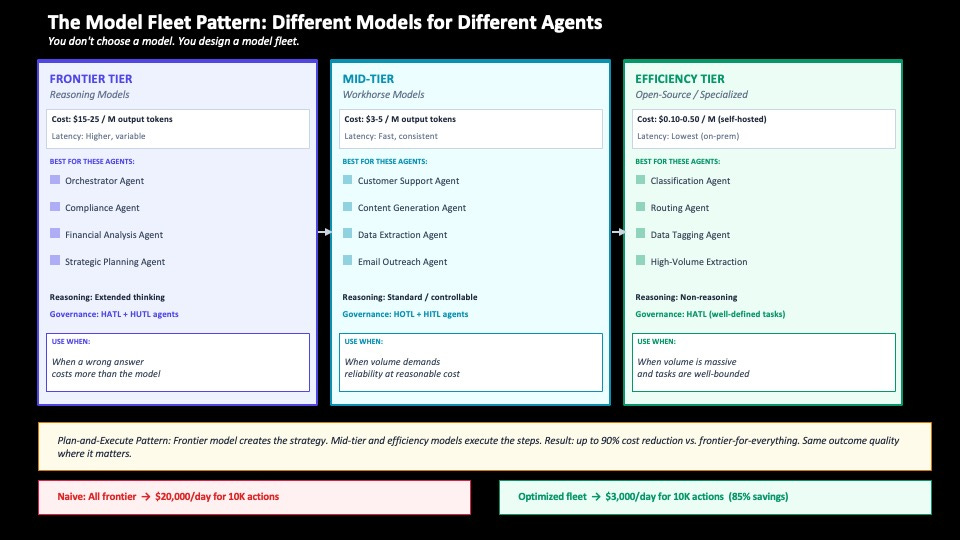
A model fleet is a deliberately heterogeneous architecture in which agents within the same system use different models based on their task requirements, cost sensitivity, latency constraints, and data sovereignty needs. This is the LLM equivalent of microservice polyglot persistence: different services use different databases because different data access patterns require different solutions.
In practice, a model fleet for an enterprise agentic system might look like this:
The orchestrator agent uses a frontier model because its decisions cascade through the entire system; a planning error at the top propagates to every downstream agent. The cost is justified by the high consequences of orchestration errors.
Customer-facing support agents use a mid-tier model because they need strong conversational quality, reliable tool calling, and the endurance for extended customer interactions, but the volume is too high for frontier pricing.
Data classification and routing agents use a small, self-hosted open-source model because they process thousands of items per hour, the task is well-defined, latency must be minimal, and the cost of frontier models would be prohibitive at this volume.
Compliance reasoning agents use a frontier model with extended thinking because regulatory interpretation requires the deepest reasoning, and the cost of a compliance error vastly exceeds the cost of model inference.
Analytics and reporting agents use a mid-tier model because they need strong, structured output generation for charts, tables, and summaries, but don’t require frontier-level reasoning.
This heterogeneous approach, often called “LLM routing,” is becoming standard practice. The economics are compelling: the Plan-and-Execute pattern, where a capable model creates a strategy that cheaper models execute, can reduce costs by up to 90% compared to using frontier models for everything.
The Six Evaluation Criteria for Agentic LLM Selection
When evaluating models for your agent fleet, assess each model against six dimensions, weighted by the specific agent’s requirements:
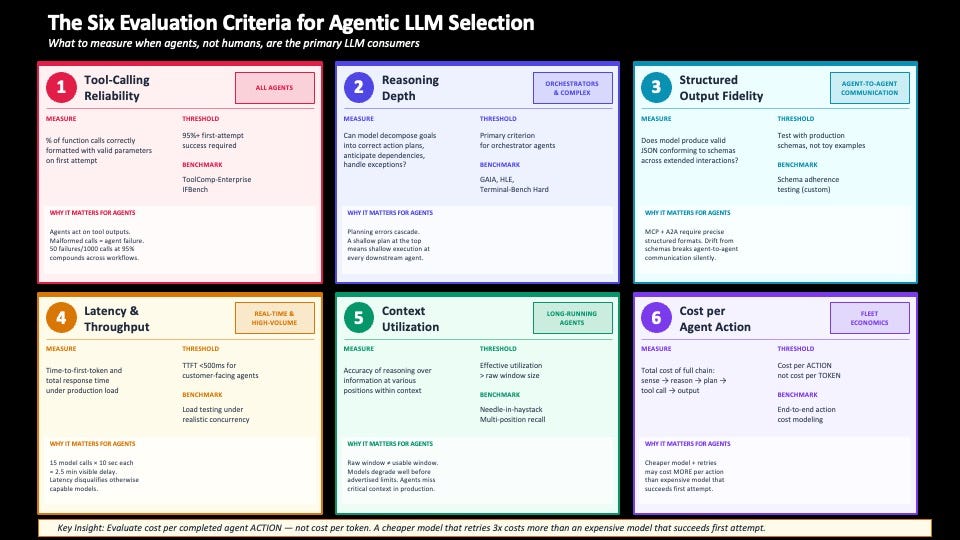
1. Tool-Calling Reliability (Critical for all agents)
Measure: What percentage of function calls are correctly formatted, with valid parameters, on the first attempt? Benchmarks like ToolComp-Enterprise and IFBench evaluate this specifically. For production agentic systems, you need 95%+ first-attempt reliability. Below that threshold, retry logic and error handling consume more engineering effort than the agent saves.
2. Reasoning Depth (Critical for orchestrators and complex agents)
Measure: Can the model decompose a multi-step goal into a correct action plan, anticipate dependencies, and handle exceptions? Benchmarks like GAIA, Humanity’s Last Exam, and Terminal-Bench Hard evaluate this. For orchestrator agents and compliance agents, reasoning depth is the primary selection criterion.
3. Structured Output Fidelity (Critical for agent-to-agent communication)
Measure: Does the model consistently produce valid JSON conforming to specified schemas across extended interactions? This matters for MCP tool invocations, A2A message formatting, and orchestration instructions. Test with realistic schemas, not toy examples. Production schemas have nested objects, arrays, enums, and optional fields.
4. Latency and Throughput (Critical for real-time and high-volume agents)
Measure: Time-to-first-token and total response time under production load. For customer-facing agents, time-to-first-token must be under 500ms. For high-volume classification agents, the total response time for a complete tool call should be under 2 seconds. Test under realistic concurrency; models that perform well in isolation may degrade under concurrent load.
5. Context Utilization (Critical for long-running agents)
Measure: Not the raw context window size, but how accurately the model reasons over information at various positions within the window. Test with information placed at the beginning, middle, and end of long contexts. Models that advertise large windows but fail “needle in a haystack” tests will cause agents to miss critical context in production.
6. Cost per Agent Action (Critical for fleet economics)
Measure: Not cost per token, but cost per completed agent action, which includes the full chain of model calls required to sense, reason, plan, invoke tools, and produce output. A cheaper model that requires multiple retries due to tool-calling failures may cost more per action than a more expensive model that succeeds on the first attempt. Factor in prompt caching. Providers offer 50-90% discounts on cached input tokens, and agent system prompts with tool descriptions are highly cacheable.
Mapping LLM Selection to the Governance Hierarchy
Article 5 introduced the Human Oversight Hierarchy. Your governance model directly constrains your LLM selection:
HITL agents can tolerate models with slightly lower reliability because a human reviews every output before action. This creates room to use more cost-effective models where the human serves as a quality backstop.
HOTL agents need higher reliability because they monitor trends, not review individual decisions. The model must be trustworthy enough that the supervisor’s dashboard shows green most of the time, not constant exception handling.
HATL agents need the highest reliability because no human is reviewing individual decisions. The model must operate autonomously within policy boundaries, and errors compound at scale before any governance mechanism catches them. For HATL agents, the more on the model, the greater the cost of errors at an autonomous scale, vastly exceeding the cost of better inference.
HUTL outputs, where humans rely on agent-generated analysis for their own decisions, require the strongest reasoning and the least hallucination. If a financial analyst is making investment decisions based on agent analysis, the model producing that analysis needs to be demonstrably accurate and calibrated.
The pattern: as agents become more autonomous, the LLM quality bar rises, not falls. Autonomy demands trustworthiness, and trustworthiness in an agentic system starts with the reliability of the underlying model.
The LLM Gateway: Infrastructure for Model Fleets
Operating a model fleet requires infrastructure that single-model deployments don’t need. The emerging standard is the LLM gateway, an abstraction layer that sits between your agents and model providers, handling routing, failover, cost management, and observability.
A production LLM gateway provides multi-model routing (routing agent requests to the appropriate model based on agent type, task complexity, or cost budget), automatic failover (if a provider is down or rate-limited, route to an alternative), unified API (agents call one endpoint; the gateway handles provider-specific formats), cost tracking per agent and per action (essential for fleet economics), and semantic caching (caching responses to identical or similar requests to reduce costs and latency).
This is not optional infrastructure for production agentic systems. Teams that deploy agents without a gateway layer discover the hard way that direct API calls to multiple providers create a fragile, expensive, and ungovernable architecture.
The Honest Gaps
Benchmarks don’t fully capture production agentic behavior. Existing benchmarks evaluate models in controlled conditions. Production agentic systems involve cascading multi-agent workflows, noisy real-world data, and edge cases that no benchmark fully represents. The gap between benchmark performance and production performance is the primary source of agentic deployment failures.
The model landscape changes faster than enterprise procurement cycles. By the time you’ve completed an enterprise evaluation and vendor negotiation, the model landscape may have shifted. Architecture for model portability—the ability to swap models without rewriting agents—is not a nice-to-have. It’s a survival requirement.
Cost modeling is still immature. Most enterprises don’t have reliable models for predicting the costs of agentic AI at scale. The variables: tokens per action, actions per workflow, workflows per day, retry rates, and caching hit rates, are complex and workload-specific. Budget for significant cost discovery during the first 90 days of any agentic deployment.
Fine-tuning for agentic use is underexplored. Most fine-tuning focuses on the quality of generated text. Fine-tuning for tool-calling reliability, structured output consistency, and domain-specific reasoning patterns is a nascent practice with limited tooling and methodology.
What This Means for Your LLM Strategy
If you’re designing an Agentic-First system, here are the strategic recommendations:
Design for a model fleet from day one. Even if you start with a single model, architect your system with an abstraction layer that makes model substitution a configuration change, not a code change. The agent layer in the reference architecture (Article 4) should be model-agnostic; the model is a dependency of the agent, not a dependency of the architecture.
Match model tier to agent governance level. HATL agents get frontier models. HITL agents can use mid-tier. High-volume HATL agents with well-defined tasks can use a self-hosted, open-source solution. The governance hierarchy outlined in Article 5 serves as your guide to model selection.
Invest in an LLM gateway early. The routing, failover, cost management, and observability infrastructure of a gateway pays for itself within the first month of production operation. Treat it as foundational infrastructure, not an optimization.
Measure cost per agent action, not cost per token. The total cost of an agent completing a procurement approval, resolving a customer ticket, or generating a content piece is what matters, not the input token price. A reliable model that costs more per token but completes actions in fewer attempts may be cheaper per action.
Budget for continuous model evaluation. The model you select today will not be the model you use in 18 months. Build an evaluation infrastructure that continuously benchmarks new models against your specific agentic workloads, tool calls with your schemas, reasoning over your domains, and structured outputs that match your protocols.
Use the reference architecture as your selection framework. Map each layer of the architecture to model requirements. The orchestration layer needs the strongest reasoning. The agent layer needs a reliable tool for calling. The experience layer needs low latency and conversational quality. Different layers, different models.
The model is not the agent. The agent is a system that uses a model as one component among many, alongside MCP connections, A2A protocols, orchestration logic, governance policies, and the data and context that enable reasoning. Choose your models the way you choose any architectural component: fit for purpose, replaceable by design, and governed by the same framework that governs everything else in your Agentic-First system.
This is the sixth article in my Agentic-First Architecture series. Article 1 introduced the paradigm. Articles 2 and 3 defined the protocol stack (MCP + A2A). Article 4 published the reference architecture. Article 5 defined the Human Oversight Hierarchy. Article 7 will address data architecture for agentic systems and why your data strategy is your agent strategy. All previous articles are available on my Substack.
I’d welcome feedback from architects who’ve operationalized model fleets: what routing patterns are working? What cost surprises did you encounter? How are you handling model evaluation in production?
#AgenticAI #LLM #EnterpriseArchitecture #ModelSelection #AgentFirstArchitecture #AIStrategy