

In the first article of this series, I made the case for Agentic-First Architecture, the next paradigm shift after MACH, where autonomous AI agents become the primary actors in enterprise systems. In the second, I explained why MCP (the Model Context Protocol) is the plumbing that makes this possible, the standardized way agents discover and interact with tools, data, and services.
But there’s a gap in that story. A critical one.
MCP solves how a single agent connects to the world. It doesn’t solve how agents connect to each other. And in any enterprise of meaningful complexity, no single agent can do it all. You need a procurement agent who talks to a supplier’s fulfillment agent. A sales agent who coordinates with a marketing agent. A compliance agent that monitors what every other agent is doing. An HR agent who collaborates with an external background-check agent.
This is the multi-agent collaboration problem. And it’s the problem that the Agent-to-Agent protocol - A2A - was built to solve.
The Problem A2A Addresses: The Multi-Agent Coordination Gap
Let me make this concrete with a scenario every enterprise architect will recognize.
A hiring manager asks their AI agent: “Find me a senior data engineer in Chicago who can start within 30 days.” In an Agentic-First system, this single request should trigger a cascade of coordinated agent actions: a talent sourcing agent searches candidate databases, a scheduling agent coordinates interview availability, a compensation agent benchmarks market rates, a background-check agent (potentially operated by an external provider) verifies credentials, and an onboarding agent prepares systems access.
These aren’t tools. They’re agents, autonomous entities with their own reasoning capabilities, their own data, their own decision-making logic, and potentially their own vendors. A CRM tool responds to function calls. An agent reasons, negotiates, asks clarifying questions, and decides how to complete a task. The interaction model is fundamentally different.
MCP is designed for the first pattern, agent-to-tool communication. A2A is designed for the second, agent-to-agent collaboration. They’re not competing protocols. They’re complementary layers in the same architecture.
What A2A Actually Is: The Technical Foundation
The Agent-to-Agent protocol (A2A) is an open standard introduced by Google at Cloud Next in April 2025, now governed by the Linux Foundation with support from over 150 organizations, including AWS, Microsoft, Cisco, Salesforce, SAP, ServiceNow, Atlassian, MongoDB, and PayPal.
Where MCP standardizes how agents interact with tools and data, A2A standardizes how agents interact with each other, across vendors, frameworks, and organizational boundaries. IBM describes it well: A2A is “a common language or universal translator for agent ecosystems.”
At the protocol level, A2A shares DNA with MCP, it uses JSON-RPC 2.0 over HTTPS, building on the same established web standards. But the abstractions are designed for a fundamentally different interaction pattern.
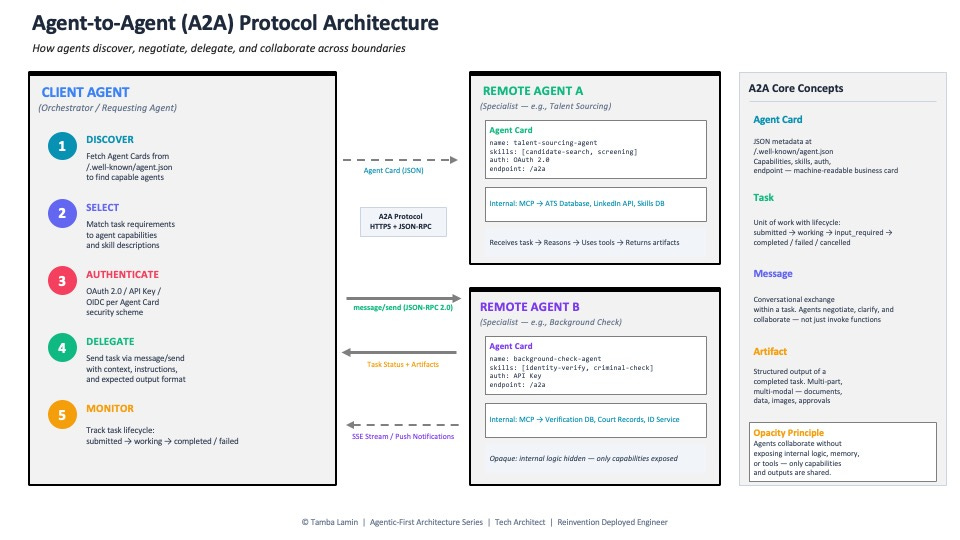
The Four Core Concepts
Agent Cards are how agents advertise themselves to the world. Every A2A agent publishes a JSON document (at /.well-known/agent.json) describing its name, capabilities, skills, supported interaction modalities, authentication requirements, and endpoint. Think of an Agent Card as a machine-readable business card, it tells other agents what this agent can do, how to reach it, and how to authenticate. This enables dynamic discovery: a client agent can scan available Agent Cards and select the right specialist agent for a given task without pre-configuration.
Tasks are the unit of work in A2A. When one agent asks another to do something, it creates a task with a defined lifecycle. Tasks can be completed immediately (synchronously) or run over extended periods (asynchronously), progressing through states such as submitted, working, input_required, completed, failed, and cancelled. This lifecycle management is critical for enterprise workflows where actions take hours or days, not milliseconds.
Messages are how agents communicate within a task. A client agent sends a message to a remote agent with context, instructions, or clarifying information. The remote agent responds with updates, questions, or results. This back-and-forth, conversational interaction model is what distinguishes A2A from tool-calling. Agents don’t just invoke functions, they negotiate, clarify, and collaborate.
Artifacts are the structured outputs of completed tasks, generated documents, datasets, analysis results, and approval records. Artifacts can contain multiple parts with different content types, enabling rich multimodal exchange between agents.
The Opacity Principle: Why It Matters for Enterprises
A2A is designed around a critical architectural principle: agents collaborate without exposing their internal workings. A remote agent doesn’t need to share its internal memory, proprietary logic, tool implementations, or model architecture with the agents it collaborates with. It only exposes its capabilities (via Agent Card) and its outputs (via Artifacts).
This is architecturally significant for two reasons. First, it protects intellectual property, your proprietary agents can collaborate with a partner’s agents without either side revealing their competitive advantage. Second, it maps to how enterprises actually work. When your procurement department works with a supplier, they exchange requests and deliverables, not internal process documentation.
How MCP and A2A Work Together: The Complete Protocol Stack
This is where the architecture becomes clear, and where I think most coverage of these protocols falls short. MCP and A2A aren’t alternatives, they’re layers in a complete Agentic-First protocol stack.
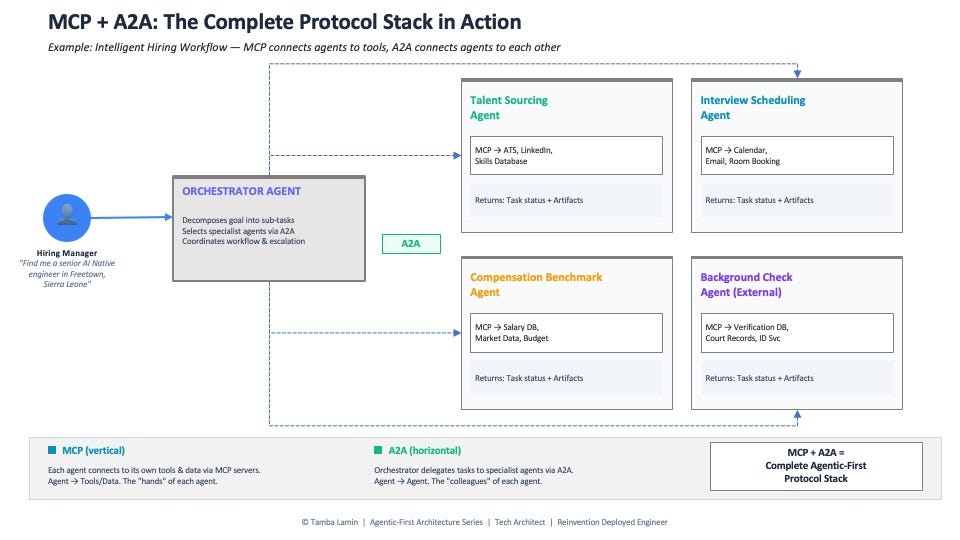
MCP is the vertical protocol, it connects agents downward to tools, data sources, and services. An agent uses MCP to query a database, invoke an API, read a document, or execute a function. MCP handles the “agent interacts with the world” layer.
A2A is the horizontal protocol, it connects agents laterally to other agents. An agent uses A2A to delegate tasks, request collaboration, exchange context, and coordinate complex multi-step workflows across organizational and vendor boundaries. A2A handles the “agents work together” layer.
Consider the hiring example again. The hiring manager’s agent uses A2A to delegate candidate sourcing to a talent agent, interview scheduling to a calendar agent, and background checks to an external verification agent. Each of those specialist agents, internally, uses MCP to connect to their respective tools and data, the talent agent queries the ATS database via MCP, the calendar agent accesses scheduling systems via MCP, and the background-check agent connects to verification databases via MCP.
The analogy to networking is useful here. AWS explicitly drew this parallel in their blog series: in networking, TCP and UDP serve different communication patterns at the same IP layer. Similarly, MCP and A2A serve different agent interaction patterns over the same enterprise infrastructure. MCP is like TCP, reliable, structured, tool-oriented communication. A2A is like UDP, lightweight, task-oriented, agent-to-agent messaging designed for autonomous collaboration.
The formula for the complete Agentic-First protocol stack:
MCP (agent-to-tool) + A2A (agent-to-agent) = the full nervous system of Agentic-First Architecture.
Without MCP, agents can’t act in the world. Without A2A, agents can’t act together. You need both.
Why A2A Matters for Agentic-First Architecture: Five Arguments
1. A2A Enables True Multi-Agent Systems at Enterprise Scale
In my first article, I argued that one of the key advantages of Agentic-First systems is cross-system intelligence, agents spanning CRM, ERP, and DXP boundaries to make decisions that no single-system workflow could. A2A is the protocol that enables standardized, scalable cross-system collaboration. Without it, multi-agent orchestration remains a custom integration project for every agent pair.
2. A2A Preserves Agent Autonomy While Enabling Collaboration
Traditional workflow automation requires every step to be predefined. A2A-based collaboration preserves each agent’s autonomy, agents decide how to complete delegated tasks, not just execute pre-programmed steps. The client agent says, “Find me qualified candidates.” The talent agent decides how to search, what criteria to prioritize, and what trade-offs to make. This is the difference between orchestration and collaboration, and it’s foundational to the Agentic-First paradigm.
3. A2A Makes Agent Ecosystems Composable Across Organizations
MCP makes agents composable within an organization, connecting them to internal tools and data. A2A extends that composability across organizational boundaries. Your agent can collaborate with a supplier’s agent, a partner’s agent, or a SaaS vendor’s agent, all through the same standardized protocol. This is what Cisco’s VP called “an open, interoperable Internet of Agents”, and it’s the enterprise equivalent of APIs that enable the platform economy.
4. A2A Brings Enterprise-Grade Security to Agent Collaboration
A2A was designed with enterprise security as a first principle, not an afterthought. Agent Cards include authentication schemes aligned with OpenAPI standards (API keys, OAuth 2.0, OpenID Connect). Communication occurs over HTTPS with TLS. The opacity principle means agents never need to expose their internal state. Version 0.3 (July 2025) added gRPC support, signed security cards, and extended SDK capabilities specifically for enterprise hardening.
5. A2A Creates the Foundation for Agent Marketplaces
When agents can discover each other through standardized Agent Cards, collaborate through standardized tasks, and exchange results through standardized artifacts, the conditions exist for agent marketplaces, ecosystems where specialized agents from different vendors can be composed on demand. Google is already building toward this with Agent Engine deployment paths and the ADK integration ecosystem. This is the SaaS marketplace equivalent for the agentic era.
The A2A Ecosystem: Momentum and Milestones
April 2025: Google launches A2A at Cloud Next with 50+ technology partners. The protocol is released under the Apache 2.0 license.
June 2025: Google donates A2A to the Linux Foundation. AWS, Microsoft, Cisco, Salesforce, SAP, and ServiceNow join as supporting organizations. The ecosystem grows to 100+ partner organizations.
July 2025: Version 0.3 released with gRPC support, signed security cards, and an extended Python SDK. The ecosystem surpasses 150 organizations.
August 2025: The Linux Foundation launches agentgateway, an AI-native proxy supporting both A2A and MCP, with contributions from AWS, Cisco, IBM, Microsoft, Red Hat, and Shell. T-Mobile publicly endorses the project.
2026: Real-world enterprise deployments emerge. Tyson Foods and Gordon Food Service build collaborative A2A systems to coordinate the supply chain. AWS releases A2A support in Strands Agents SDK. Google integrates native A2A support into ADK.
The trajectory mirrors MCP’s, but with a notable difference. A2A launched with cross-industry governance from day one, learning that protocol neutrality accelerates adoption.
A2A’s Honest Gaps: What Architects Should Watch
The specification is still maturing. A2A is younger than MCP and still evolving. Authorization schemes, dynamic skill discovery, and UX negotiation are on the roadmap but not yet finalized. Early adopters should expect breaking changes.
Latency in multi-agent chains. Cross-agent orchestration adds communication overhead. When a task chains through three or four agents, each with its own reasoning cycle, end-to-end latency can become significant. Architects need to design for asynchronous patterns from the start.
Observability across agent boundaries. Tracing a request through multiple autonomous agents, each potentially operated by different organizations, is harder than tracing a single agent’s tool calls. A2A’s structured task lifecycle helps, and the protocol supports OpenTelemetry, but the tooling ecosystem is nascent.
Governance of cross-organizational agent interactions. When your agent delegates a task to an external partner’s agent, who is accountable for the outcome? Existing compliance frameworks weren’t designed for autonomous inter-organizational collaboration. This is a policy challenge as much as a technical one.
Adoption asymmetry with MCP. MCP has a 12-month head start and far broader tool-level adoption. Many organizations building MCP servers haven’t yet considered A2A. The risk is building deep agent-to-tool capabilities without the agent-to-agent collaboration layer, which limits the architectural ceiling.
What This Means for Your Platform Strategy
Think in protocol layers, not individual protocols. Your agentic architecture needs both MCP (vertical: agent-to-tool) and A2A (horizontal: agent-to-agent). Evaluating one without the other gives you an incomplete picture. Ask your platform vendors: Do you support both? Where are you on each roadmap?
Design your agents to be A2A-discoverable from the start. Even if you’re not ready for full multi-agent collaboration, publishing Agent Cards for your key agents costs almost nothing and positions you for composability when the ecosystem matures.
Identify your cross-boundary collaboration points. Where do your current processes require handoffs between departments, business units, or external partners? Those are your highest-value A2A use cases, the places where agent-to-agent collaboration can eliminate the coordination overhead that slows your operations.
Invest in the team model. As I discussed in my first article, building agentic systems requires cross-functional teams, RDEs who reimagine processes, FDEs who solve integration challenges, and deep industry and process SMEs who ensure the result works in the real world. A2A adds another dimension: your team needs to understand how to design agents that collaborate, not just agents that act.
Start with internal A2A before external. Begin by connecting your own agents across departments and systems. Get the patterns, governance, and observability right internally before extending to external agent ecosystems. The protocol is the same, but the trust and governance models are very different.
The Bigger Picture: The Complete Agentic-First Stack
Let me step back and connect all three articles in this series.
Agentic-First Architecture is the paradigm, systems designed with agents as first-class citizens, where traditional forms and workflows become governance layers rather than the primary interface.
MCP is the vertical protocol, how agents connect to tools, data, and services. It solves the N×M integration problem and enables agent capabilities to be composed across enterprise systems.
A2A is the horizontal protocol, how agents connect to each other. It solves the multi-agent coordination problem and makes agent collaboration possible across vendors, frameworks, and organizational boundaries.
Together, they form the complete protocol stack for Agentic-First systems. MCP gives agents a hand. A2A gives agents colleagues. The paradigm gives them purpose.
The organizations that understand this full stack, not just one piece of it, will be the ones that define the next era of enterprise technology. The ones that don’t will spend the next decade retrofitting.
This is the third article in my Agentic-First Architecture series. Article 1 (“From Monolith to MACH to Agentic-First Architecture”) introduced the paradigm. Article 2 (“MCP: The Protocol Layer That Makes Agentic-First Architecture Possible”) covered the agent-to-tool protocol. Both are available on my Substack.
I’d love to hear from architects and technology leaders: are you already designing for multi-agent collaboration? Where are you seeing the MCP + A2A complementarity play out in your enterprise environments?
#A2A #AgentToAgent #AgenticAI #MCP #EnterpriseArchitecture #AI #AgentFirstArchitecture